
Short Answer
The Giza Pyramids stand as monumental testaments to ancient engineering, enveloped in mystique and often debated by scholars, enthusiasts, and conspiracy theorists alike. These colossal structures, built as eternal resting places for pharaohs, prompt a myriad of questions that tantalize the mind: How were they constructed? What secrets lie within? Are these grand edifices mere mausoleums, or could they hold the keys to ancient knowledge—or even extraterrestrial contact? As we plunge into the enigma of the Giza Pyramids, we invite you to ponder this playful challenge: What do you believe—could pharaohs have truly devised traps for would-be tomb robbers, or is there a more cosmic explanation for their architectural genius?
To engage fully with the wonders of these ancient structures, we will traverse their historical significance, delve into the theories of pharaonic traps, and explore the more sensational narratives involving alien involvement. Each aspect embodies a piece of the intricate puzzle that invites speculation and wonder.
The Historical Context of the Giza Pyramids
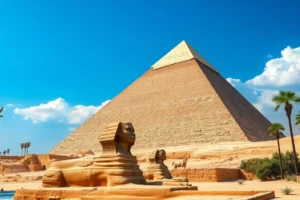
Built during the Fourth Dynasty of the Old Kingdom, approximately 2580 to 2560 BCE, the Pyramids of Giza were conceived as monumental tombs for the pharaohs Khufu, Khafre, and Menkaure. The Great Pyramid of Khufu, the largest of the three, originally soared to about 146.6 meters (481 feet) high and was the tallest man-made structure in the world for over 3,800 years. The architectural precision and sheer scale of these pyramids continue to baffle experts.
The builders employed an advanced understanding of mathematics and astronomy. The alignment of the pyramids with specific stars and constellations has led many to believe that they were constructed with religious or astronomical significance in mind. The contemplation of such celestial connections prompts one to ask: Were the ancient Egyptians simply extraordinary mathematicians and artisans, or did they possess knowledge that has since been lost to history?
Pharaohs’ Traps: Myth or Reality?
Among the labyrinthine passages of the Great Pyramid, stories have circulated about pharaonic traps designed to deter tomb robbers. While the history of tomb raiding is well-documented, the existence of traps remains largely speculative. Some claim these traps could encompass shifting stones, concealed pitfalls, or even elaborate mechanisms to shift the very architecture itself. Such tales echo the legendary traps mentioned in the story of King Tutankhamun’s tomb.
Moreover, certain structural features within the pyramids, such as hidden chambers and sealed passageways, have fueled the imagination. Could these be remnants of pharaonic cunning? Perhaps the ancients planned not just for the afterlife but also sought to protect their legacies from the unworthy.
Yet, as one contemplates these potential defenses, it is essential to weigh the credibility of archaeological evidence against anecdotal tales. The absence of confirmed traps raises an intriguing question: What might the motivations have been for such elaborate precautions if they existed?
Alien Theories: An Out-of-This-World Explanation?
While pharaohs and their ingenious techniques invite scrutiny, the narrative takes a fantastical twist with the introduction of alien theories. Proponents of these ideas posit that the construction techniques required to erect the pyramids were beyond the capability of the ancient Egyptians and suggest that extraterrestrial beings provided assistance.
Supporters emphasize the pyramids’ enigmatic designs, which exhibit such precision that it seems implausible for human hands to have executed them without advanced technologies. Such theories assert that ancient texts and religious iconography may hold hidden clues regarding interstellar interactions. Artifacts and depictions of extraordinary celestial bodies lead some to hypothesize that extraterrestrials inspired architectural styles.
Rebuttals to these theories often highlight the sophistication of ancient Egyptian culture, arguing that the expertise required to construct such monumental edifices stemmed from thousands of years of accumulated knowledge and experience. Nonetheless, the possibility of alien involvement transforms the Giza Pyramids from mere tombs into a cosmic riddle—one that beckons imaginative exploration.
The Interplay of Mystique and Scholarship
The captivating allure of the Giza Pyramids perpetuates a delicate balance between scholarship and speculation. Scholars must elucidate the remarkable achievements of ancient Egyptians while simultaneously combating the sensational claims that obscure factual understanding. Unveiling the truth of what lies within these massive structures requires a multidisciplinary approach, involving archaeology, Egyptology, and even astronomy.
The multifaceted enigma of the Giza Pyramids serves not just to enlighten but to inspire wonder. The very questions they pose to humanity compel us to investigate not only their stone and mortar but also our fundamental yearning to comprehend existence itself. As you’ve journeyed through tales of tomb traps and alien theories, one must wonder—are we on the precipice of awakening dormant knowledge encoded in the pyramids, or are we merely artifacts of our own imagination?
As we navigate these eternal enigmas, the Giza Pyramids beckon us to delve deeper, encouraging exploration beyond the surface of established history. The grandeur of these structures stands not just as a testament to the pharaohs and their builders but also as a mirror reflecting our own quest for understanding in the vast cosmos.
FAQ
When were the Giza Pyramids constructed?
The pyramids were built during Egypt's Fourth Dynasty, approximately between 2580 and 2560 BCE.
Are there confirmed traps inside the Giza Pyramids?
No confirmed traps have been found; tales of pharaohs' traps remain speculative.
What do alien theories say about the pyramids?
They suggest extraterrestrial beings helped build the pyramids due to their precise construction, though this is not supported by mainstream archaeology.
Why are the pyramids aligned with stars?
The alignment likely had religious or astronomical significance for the ancient Egyptians.




Leave a Reply