
Short Answer
21 Facts About Umbrellabirds (Another Variety)
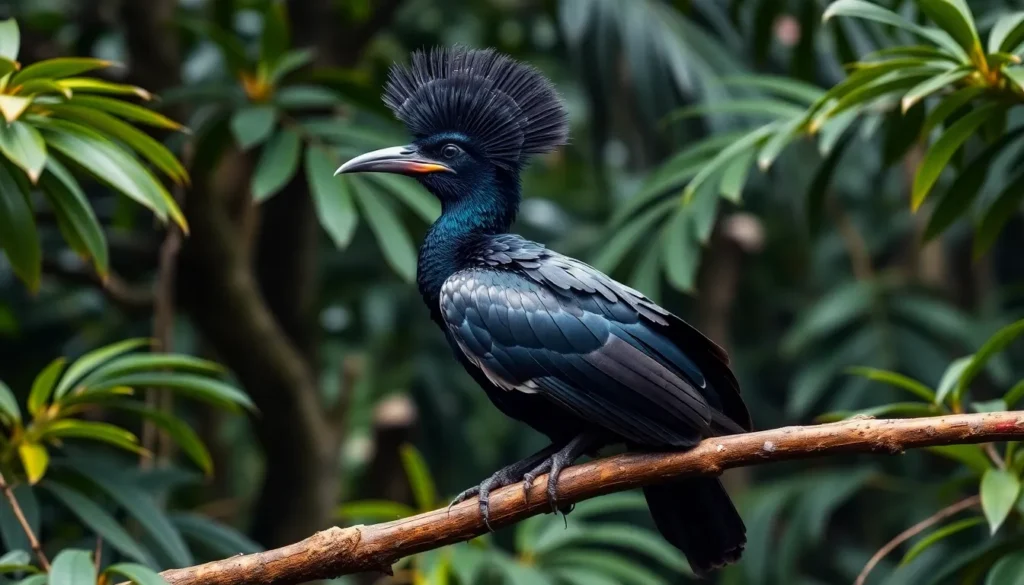
- Distinctive Crest: Umbrellabirds have a unique umbrella-shaped crest of feathers on their heads, which they can raise or lower.
- Family Classification: They belong to the family Cotingidae, which includes other spectacularly plumaged birds from Central and South America.
- Size: Umbrellabirds are relatively large passerines, with some species reaching up to 40 cm (16 inches) in length.
- Vocalizations: Their calls are deep and resonant, often described as booming or hollow sounds used in communication and mating displays.
- Sexual Dimorphism: Males are typically larger and have more prominent crests and throat sacs compared to females.
- Throat Sac: Many umbrellabird species possess an inflatable throat sac that amplifies their calls during mating season.
- Diet: They primarily feed on fruits, supplemented by insects and small animals, making them important seed dispersers.
- Habitat: Umbrellabirds inhabit humid tropical forests, especially in lowland and montane regions of Central and South America.
- Geographic Range: Their range includes countries such as Colombia, Ecuador, Panama, and Peru.
- Nesting: Females usually build nests high in the canopy, where they lay and incubate eggs alone.
- Reproduction: Males perform elaborate displays involving posture, crest raising, and vocalizations to attract females.
- Conservation Status: Some umbrellabird species are considered vulnerable or near threatened due to habitat loss and fragmentation.
- Flight: Umbrellabirds are strong fliers but tend to be somewhat slow and deliberate in movement.
- Social Behavior: They are generally solitary or found in small groups outside the breeding season.
- Camouflage: Their dark plumage helps them blend into the shaded understory and canopy of dense forests.
- Longevity: In the wild, umbrellabirds can live several years, although exact lifespan data is limited.
- Ecological Role: They play a vital role in seed dispersal, contributing to forest regeneration and biodiversity.
- Predators: Predators include large birds of prey and arboreal mammals, but umbrellabirds rely on camouflage and flight to evade them.
- Research Challenges: Due to their secretive nature and dense habitat, umbrellabirds are challenging to study in the wild.
- Variation Among Species: There are multiple species of umbrellabirds, each differing slightly in size, call, and crest shape.
- Cultural Significance: In some indigenous cultures, umbrellabirds are featured in folklore and regarded as symbols of the forest.
Habitat and Behavior
Umbrellabirds primarily inhabit humid tropical forests, including lowland rainforests and montane cloud forests across Central and South America. They prefer dense, mature forests where tall trees provide ample cover and fruiting trees abound. These birds are generally solitary or found in pairs, especially during the breeding season when males perform vocal and visual displays to attract mates. Females are responsible for nest building and chick rearing, usually placing nests high in the canopy to reduce predation risks. Umbrellabirds feed mainly on fruit, which they swallow whole, aiding in seed dispersal for many tree species. Their behavior is adapted to a life largely in the forest canopy, with strong but somewhat slow flight patterns. Vocalizations, including deep booming calls amplified by their throat sacs, are crucial for communication in dense forest environments.
Why This Animal Matters
Ecologically, umbrellabirds serve as important seed dispersers, facilitating the regeneration and maintenance of tropical forest ecosystems. By consuming and excreting seeds far from the parent plants, they help sustain plant diversity and forest dynamics. Their presence indicates healthy, undisturbed habitats, making them valuable bioindicators. From a conservation perspective, umbrellabirds highlight the challenges of tropical forest preservation, as habitat loss continues to threaten many species. Culturally, some indigenous communities recognize umbrellabirds in myths and stories, reflecting the birds’ significance within local natural heritage. Protecting umbrellabirds and their habitats contributes to broader biodiversity conservation goals and supports ecosystem resilience.
Common Misconceptions
Misconception: Umbrellabirds are related to umbrellas or rain gear.
Correction: The name “umbrellabird” derives from their umbrella-shaped crest, not any association with umbrellas or rain protection.
Misconception: All umbrellabird species are endangered.
Correction: While some species are vulnerable or near threatened, not all umbrellabirds are currently endangered; conservation status varies by species.
Misconception: Umbrellabirds are loud and noisy at all times.
Correction: They vocalize primarily during breeding seasons; otherwise, they are relatively quiet and secretive.
Misconception: Umbrellabirds only eat insects.
Correction: Their diet is mainly frugivorous, supplemented by insects and small animals but predominantly fruit.
Misconception: Umbrellabirds are easy to spot due to their size.
Correction: Despite their size, their dark coloration and forest habitat make them elusive and difficult to observe.
FAQ
What do umbrellabirds eat?
Umbrellabirds primarily eat fruit, which makes them important seed dispersers. They also supplement their diet with insects and small animals.
Where can you find umbrellabirds?
Umbrellabirds inhabit humid tropical forests in Central and South America, including countries like Colombia, Ecuador, Panama, and Peru.
Why are umbrellabirds named so?
They are named 'umbrellabirds' because of their distinctive umbrella-shaped crest of feathers on their heads, which resembles an open umbrella.




Leave a Reply