
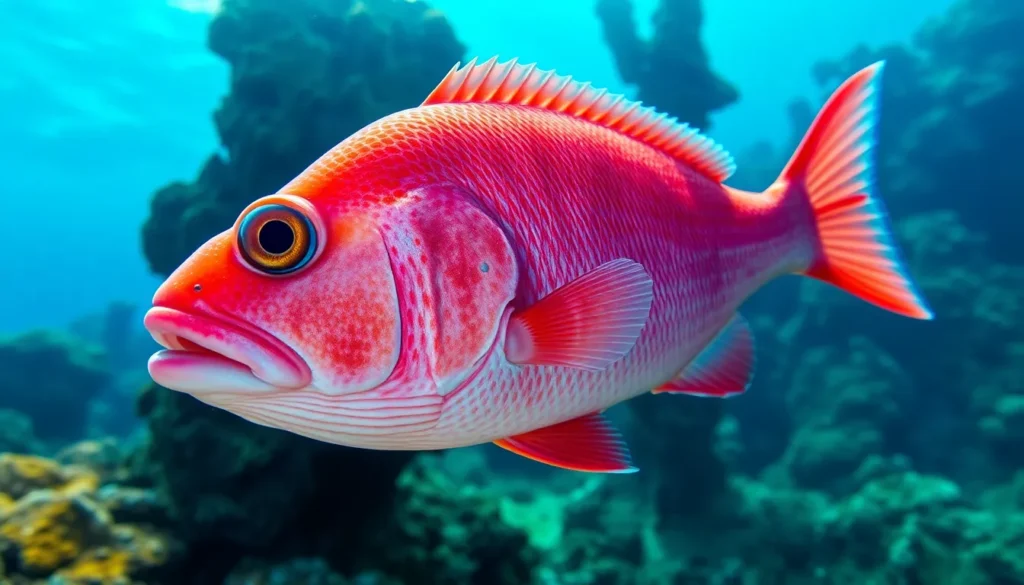
Short Answer
21 Facts About Queen Snapper (Fish)
- Scientific Classification: The queen snapper is scientifically known as Etelis oculatus and belongs to the family Lutjanidae.
- Appearance: It is characterized by a reddish-pink body with a distinctive large eye, which helps it see in deep waters.
- Size: Queen snappers can grow up to 90 cm (about 35 inches) in length, with some individuals reaching weights over 10 kg (22 lbs).
- Distribution: The species is primarily found in the western Atlantic Ocean, ranging from North Carolina to northern South America and throughout the Caribbean Sea.
- Habitat Depth: Queen snappers inhabit deepwater reefs and rocky bottoms typically between 90 and 400 meters (295 to 1,312 feet) deep.
- Diet: They are carnivorous, feeding mainly on smaller fish, squid, and crustaceans.
- Behavior: Queen snappers are generally solitary or found in small groups, often staying close to the reef structure.
- Reproduction: Spawning occurs seasonally, often during warmer months, with females releasing eggs into open water.
- Lifespan: They can live for more than 15 years in the wild.
- Commercial Importance: Queen snapper is a valuable species for commercial fisheries, especially in the Caribbean and parts of the Gulf of Mexico.
- Recreational Fishing: It is also popular among recreational anglers due to its size and fighting ability.
- Fishing Methods: Commonly caught using bottom longlines, traps, and hook-and-line gear.
- Conservation Status: Currently, the queen snapper is not listed as threatened or endangered, but overfishing concerns exist in some areas.
- Population Trends: Some populations have shown declines due to fishing pressures and habitat degradation.
- Role in Ecosystem: As a mid-level predator, queen snapper helps maintain the balance of reef fish communities by preying on smaller species.
- Camouflage: Its coloration helps it blend with the reef environment, providing some protection from predators.
- Adaptations: Large eyes are an adaptation to low light conditions in deepwater habitats.
- Growth Rate: Queen snappers have a relatively slow growth rate compared to other snapper species.
- Economic Impact: The species contributes to the livelihoods of many fishing communities in the Caribbean region.
- Culinary Use: Queen snapper is prized for its firm, white flesh and is commonly prepared grilled, baked, or fried.
- Research Importance: Studies on queen snapper contribute to understanding deepwater reef ecology and sustainable fisheries management.
Habitat and Behavior
The queen snapper inhabits deepwater reef environments primarily in the western Atlantic Ocean, including the Caribbean Sea and Gulf of Mexico. It prefers rocky substrates and ledges at depths ranging from 90 to 400 meters, where light penetration is low, necessitating its large eyes for effective vision. This species is mostly solitary or found in small groups and tends to remain close to the reef structures. It is an opportunistic carnivore, feeding mainly on smaller fish, squid, and crustaceans, which it hunts during the night or in dim light conditions. The queen snapper reproduces seasonally, releasing eggs into the water column, where larvae develop before settling to the reef. Its relatively slow growth and long lifespan make it vulnerable to overfishing, especially in areas without effective management.
Why This Animal Matters
The queen snapper plays a significant ecological role as a mid-level predator within deep reef ecosystems, helping regulate populations of smaller fish and invertebrates. Economically, it is an important species for commercial and recreational fisheries, particularly in Caribbean and Gulf of Mexico regions, supporting the livelihoods of many coastal communities. Its firm, white flesh also makes it a sought-after food fish. From a conservation perspective, understanding the biology and population dynamics of queen snapper is essential for sustainable fishery management to prevent overexploitation. Additionally, the species serves as an indicator of deep reef health, providing valuable data for marine biodiversity research.
Common Misconceptions
Misconception: Queen snapper is the same as the red snapper.
Correction: Although both belong to the snapper family, queen snapper (Etelis oculatus) is a distinct species with different habitat preferences, typically found in deeper waters compared to the red snapper (Lutjanus campechanus).
Misconception: Queen snapper populations are not at risk because they live in deep waters.
Correction: Despite their deepwater habitat, queen snapper populations can be vulnerable to overfishing due to slow growth rates and habitat specificity, making sustainable management important.
Misconception: Queen snapper is only found in the Caribbean.
Correction: While primarily found in the Caribbean, queen snapper also inhabits parts of the western Atlantic, including coastal waters off North and South America.
FAQ
Where is the queen snapper commonly found?
The queen snapper is commonly found in the western Atlantic Ocean, including the Caribbean Sea and the Gulf of Mexico, typically inhabiting deepwater reef environments between 90 and 400 meters in depth.
What does the queen snapper eat?
Queen snapper primarily feeds on smaller fish, squid, and crustaceans, using its large eyes to hunt effectively in low-light deepwater environments.
Is the queen snapper a threatened species?
Currently, the queen snapper is not listed as threatened or endangered, but some populations face pressure from overfishing and habitat degradation, emphasizing the need for sustainable fishery management.



Leave a Reply