
Short Answer
21 Facts About Larvaceans
- Larvaceans are tunicates. They belong to the class Appendicularia, a group of small marine animals closely related to sea squirts and vertebrates.
- They retain a tadpole-like form throughout life. Unlike other tunicates, larvaceans do not undergo metamorphosis and maintain a free-swimming larval form.
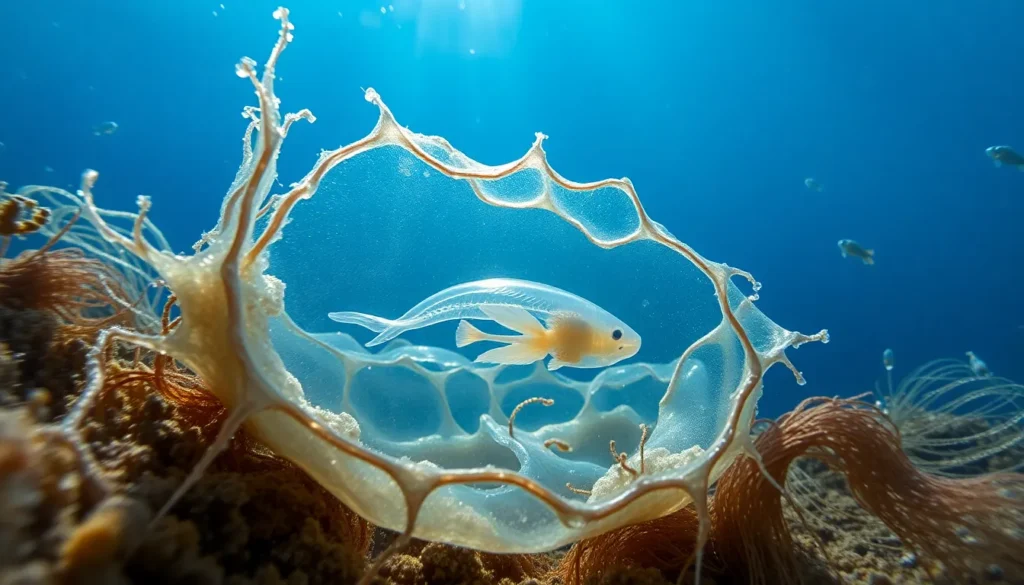
- Larvaceans build mucous houses. These transparent structures surround the animal and function as complex filters to capture food particles from the water.
- Mucous houses are regularly discarded. Larvaceans frequently abandon and rebuild their houses, which can occur several times per day.
- The discarded houses contribute to marine snow. These sinking mucous structures transport organic material to deeper ocean layers, aiding carbon sequestration.
- They are filter feeders. Larvaceans filter tiny plankton and detritus from seawater using their mucous filters.
- Larvaceans are typically small. Most species range from 1 to 10 millimeters in body length, excluding their mucous houses.
- They inhabit a range of ocean depths. Larvaceans are found from surface waters down to deep ocean zones, including the mesopelagic and bathypelagic layers.
- Some species produce bioluminescence. Certain larvaceans can emit light, which may play a role in predator avoidance or communication.
- They have a simple body plan. Their bodies include a notochord, a tail for swimming, a mouth, and a pharynx for feeding.
- Larvaceans are hermaphroditic. Many species possess both male and female reproductive organs, allowing flexible reproduction strategies.
- They reproduce sexually. Fertilization occurs externally in the water column.
- Larvaceans grow rapidly. Their short lifespan, often a few days to weeks, is marked by quick growth and frequent house replacement.
- They play a key role in ocean food webs. Larvaceans serve as prey for various fish, jellyfish, and other marine predators.
- Larvaceans help cycle nutrients. By filtering plankton and producing fecal pellets, they contribute to nutrient recycling in marine ecosystems.
- They are found worldwide. Larvaceans inhabit oceans globally, from tropical to polar regions.
- Scientists study larvaceans to understand carbon flux. Their discarded houses are important in studying biological carbon transport to deep waters.
- Larvaceans were first described in the 19th century. Early marine biologists identified their unique morphology and filter-feeding behavior during plankton surveys.
- They differ from other tunicates in lifestyle. Unlike sessile sea squirts, larvaceans remain free-swimming throughout life.
- Larvaceans can be indicators of ocean health. Changes in their populations reflect shifts in plankton communities and water quality.
- Research on larvaceans is ongoing. New species continue to be discovered, and their ecological roles are actively studied in marine biology.
Habitat and Behavior
Larvaceans live in marine environments worldwide, ranging from coastal surface waters to deep oceanic zones. They are pelagic organisms, meaning they inhabit the open water column rather than the ocean floor. Their free-swimming nature and small size allow them to efficiently filter-feed on microscopic plankton and organic particles. The hallmark of larvacean behavior is the construction and regular replacement of a mucous house, which acts as a sophisticated filter system. This house captures food particles suspended in the water, which larvaceans then consume. When the filter clogs or becomes inefficient, the larvacean abandons the old house, which sinks and contributes to the ocean’s particulate organic matter. Larvaceans exhibit rapid growth and short lifespans, and their reproductive strategy involves external fertilization. Some species produce bioluminescence, though the function of this trait remains an area of study.
Why This Animal Matters
Larvaceans play a critical role in marine ecosystems as filter feeders that regulate plankton populations and contribute to nutrient cycling. Their discarded mucous houses significantly impact the ocean’s biological carbon pump by transporting organic matter from surface waters to the deep sea, facilitating carbon sequestration. This process helps mitigate atmospheric carbon dioxide levels and supports deep-sea food webs. Larvaceans also serve as prey for a variety of marine animals, linking lower trophic levels to higher predators. Additionally, their sensitivity to environmental changes makes them valuable biological indicators for monitoring ocean health and climate change effects. Ongoing research into larvaceans enhances understanding of pelagic ecosystems and global carbon cycles.
Common Misconceptions
Misconception: Larvaceans are larval stages of other animals.
Correction: Larvaceans are fully grown adults that retain a larval-like form throughout their life, not temporary larval stages of other species.
Misconception: The mucous houses are permanent structures.
Correction: Larvaceans frequently discard and rebuild their mucous houses, sometimes multiple times per day, to maintain effective filtration.
Misconception: Larvaceans are insignificant in ocean ecosystems.
Correction: Despite their small size, larvaceans play vital roles in food webs and carbon cycling, influencing global oceanic processes.
FAQ
What are larvaceans?
Larvaceans are small, free-swimming marine animals belonging to the class Appendicularia within the tunicates. They retain a larval form and build mucous houses for filter feeding.
How do larvaceans feed?
Larvaceans feed by filtering microscopic plankton and organic particles from seawater using complex mucous houses that trap food as water passes through.
Why are larvaceans important to the ocean ecosystem?
They play a crucial role in filtering plankton, recycling nutrients, serving as prey for other marine animals, and contributing to carbon sequestration through their discarded mucous houses.



Leave a Reply