
Short Answer
21 Facts About Japanese Spider Crabs
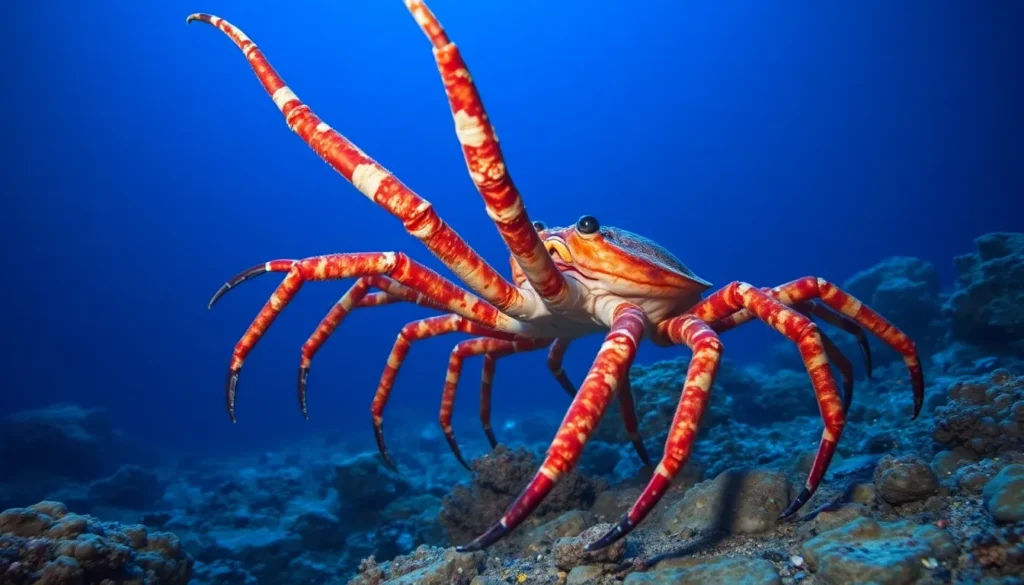
- Largest Crab Species: The Japanese spider crab is known to be the largest crab species in the world by leg span, which can reach up to 3.8 meters (12.5 feet).
- Scientific Name: Its scientific name is Macrocheira kaempferi, named after the German naturalist Engelbert Kaempfer.
- Impressive Weight: These crabs can weigh up to 19 kilograms (42 pounds), making them heavy as well as large.
- Long Legs: Despite their large size, their body is relatively small, with most of their size coming from their extremely long legs.
- Deep-Sea Dweller: They typically live at depths between 150 and 300 meters, occasionally found as deep as 600 meters.
- Native Habitat: They are native to the waters surrounding Japan, especially near the Pacific coast and around the Kii Peninsula and Suruga Bay.
- Longevity: Japanese spider crabs are believed to live up to 100 years, although precise studies on their lifespan remain limited.
- Molting Process: Like other crabs, they molt their exoskeleton to grow, a process that becomes slower and less frequent as they age.
- Omnivorous Diet: They feed on a variety of food including dead animals, shellfish, algae, and plant matter.
- Camouflage Ability: Their coloration and long legs help them blend into the ocean floor, providing effective camouflage against predators.
- Slow Movement: Due to their size and long legs, they move relatively slowly across the sea floor.
- Low Predation: Adult Japanese spider crabs have few natural predators, primarily large fish and octopuses.
- Reproductive Behavior: Females carry fertilized eggs on their abdomen until the larvae hatch; exact reproductive cycles are not fully understood.
- Juvenile Habitat Differences: Juvenile crabs often live in shallower waters than adults, which may help reduce predation risks.
- Ecological Role: They contribute to the ocean ecosystem by scavenging and cleaning dead organic material from the sea floor.
- Slow Maturation: They take several years to reach maturity, consistent with their long lifespan and slow growth rate.
- Cultural Significance: In Japan, they are sometimes featured in local folklore and are a subject of interest in marine biology and aquariums.
- Vulnerable to Fishing: The species is sometimes caught as bycatch or targeted in fisheries, which may impact population numbers.
- Conservation Status: Although not officially listed as endangered, their populations may be vulnerable due to habitat disturbance and fishing pressures.
- Unique Morphology: Their claws are asymmetrical, with one claw usually being larger and stronger used for defense and feeding.
- Scientific Interest: Japanese spider crabs are studied for their unique adaptations to deep-sea environments and their extraordinary size.
Habitat and Behavior
Japanese spider crabs inhabit the Pacific Ocean around Japan, primarily dwelling on the ocean floor at depths ranging from 150 to 300 meters, although they have been found as deep as 600 meters. Their preference for deep, cold waters helps protect them from many predators. They are benthic scavengers, feeding mainly on dead animals and plant matter, contributing to the marine ecosystem by recycling nutrients. Their slow movement and excellent camouflage enable them to avoid detection by predators. Juveniles tend to occupy shallower waters than adults, possibly as a survival strategy to reduce predation risk during early development stages. The species undergoes molting to grow, which is a vulnerable time for them due to the softness of their new exoskeleton.
Why This Animal Matters
Ecologically, Japanese spider crabs play an important role as scavengers that help maintain the health of the ocean floor by consuming dead organic material. Their presence indicates the status of deep-sea benthic ecosystems. Culturally, they hold interest in Japan for their unique appearance and size, often featured in aquariums and media. From a scientific perspective, their adaptations to deep-sea life and extraordinary morphology provide valuable insight into crustacean biology and evolutionary processes. Conservation-wise, understanding their population dynamics is important to prevent overfishing and habitat degradation, ensuring the species’ longevity in its natural environment.
Common Misconceptions
Misconception: Japanese spider crabs are aggressive and dangerous to humans.
Correction: These crabs are generally not aggressive toward humans and pose little threat due to their slow movement and deep-sea habitat.
Misconception: The large size of Japanese spider crabs means they are the heaviest crab species.
Correction: While they have the largest leg span, some other crab species can be heavier due to a bulkier body size.
Misconception: Japanese spider crabs live near the ocean surface.
Correction: They live primarily in deep waters, from 150 to 300 meters below the surface, not near shallow or surface waters.
FAQ
How big can Japanese spider crabs get?
Japanese spider crabs can have a leg span of up to 3.8 meters (12.5 feet) and weigh as much as 19 kilograms (42 pounds), making them the largest known crab species by leg span.
Where do Japanese spider crabs live?
They are native to the waters around Japan, living primarily on the ocean floor between depths of 150 and 300 meters, though they have been found as deep as 600 meters.
Are Japanese spider crabs dangerous to humans?
No, Japanese spider crabs are not typically aggressive and pose little threat to humans. Their deep-sea habitat and slow movement reduce encounters with people.
Leave a Reply