
Short Answer
21 Facts About Damselflies
- Damselflies belong to the order Odonata. They are closely related to dragonflies but differ in several anatomical and behavioral traits.
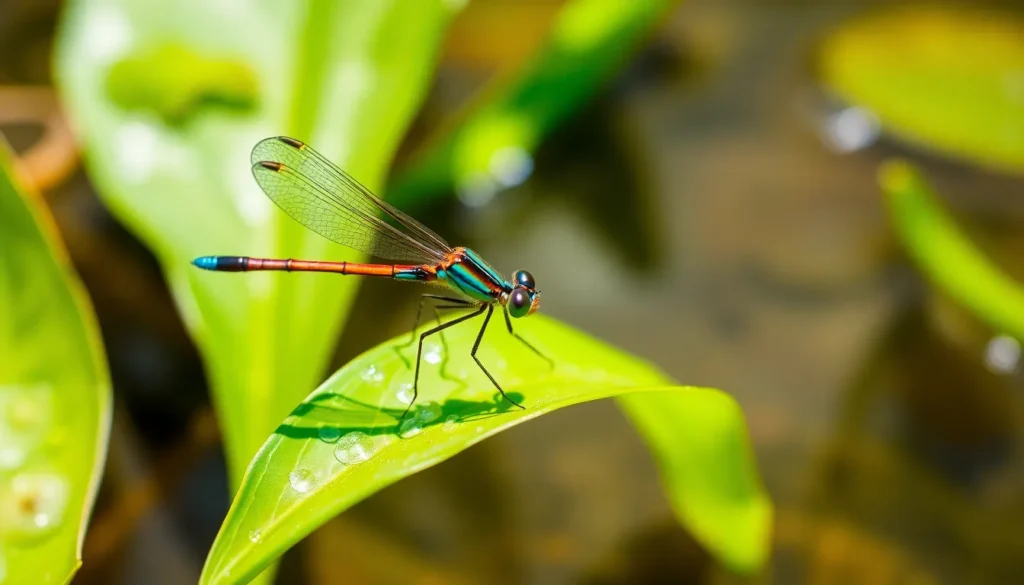
- Damselflies have slender bodies. Their bodies are generally more delicate and thinner compared to dragonflies.
- They fold their wings over their bodies when at rest. Unlike dragonflies that keep their wings extended, damselflies typically fold their wings along or above their abdomen.
- Damselflies are excellent fliers. They can hover, dart, and change direction rapidly in flight.
- They have large compound eyes. Their eyes are prominent but are set apart on either side of the head, unlike dragonflies whose eyes often touch.
- Damselflies undergo incomplete metamorphosis. Their life cycle includes egg, nymph (aquatic larva), and adult stages without a pupal phase.
- The nymphs are aquatic predators. Damselfly larvae live in freshwater habitats and are voracious hunters of other small aquatic organisms.
- Adults are also predatory. They mainly feed on small flying insects such as mosquitoes and flies.
- Damselflies use a unique mating position called the “wheel” or “heart” shape. This involves the male and female joining in a tandem position to transfer sperm.
- Colors vary widely among species. Damselflies can be brightly colored in blues, greens, reds, and sometimes metallic hues.
- Some species exhibit sexual dimorphism. Males and females often differ in color and size.
- Damselflies are found worldwide. They inhabit a wide range of freshwater environments globally, except for extremely cold regions.
- Their wings are transparent and delicate. Veins in the wings provide structural support and can be species-specific in pattern.
- Damselflies play a role in controlling insect populations. Both larvae and adults help reduce pest insects in their ecosystems.
- They have a relatively short adult lifespan. Most adults live only a few weeks to a couple of months.
- Damselflies can be indicators of healthy freshwater ecosystems. Their presence often signals clean, unpolluted water bodies.
- Some damselfly species are territorial. Males may defend breeding sites against rivals.
- Damselflies communicate using visual signals. Bright colors and wing movements are part of their interaction during mating and territorial disputes.
- They are prey for many animals. Birds, fish, amphibians, and larger insects often prey on damselflies.
- Damselflies have been studied for their flight mechanics. Their ability to maneuver has inspired research in biomimetics and robotics.
- Conservation concerns exist for some species. Habitat loss and water pollution threaten certain damselfly populations worldwide.
Habitat and Behavior
Damselflies are primarily associated with freshwater habitats such as ponds, lakes, rivers, and streams where their aquatic nymphs develop. They require clean, oxygen-rich water to thrive. Adults are often seen near these water bodies, resting on vegetation or flying low over the surface. Damselflies are diurnal and rely heavily on vision for hunting and mating. Their behavior includes territorial defense by males, complex mating rituals involving tandem flight and the characteristic “wheel” formation, and oviposition where females lay eggs on aquatic plants or submerged substrates. The nymphs are sit-and-wait predators that ambush small aquatic invertebrates. The entire life cycle duration varies depending on species and environmental conditions, but typically ranges from several months to a year.
Why This Animal Matters
Damselflies play an important ecological role as both predators and prey within freshwater ecosystems. They help control populations of pest insects such as mosquitoes, contributing to natural biological control. Their sensitivity to water quality makes them valuable bioindicators for environmental monitoring. Additionally, damselflies contribute to biodiversity and serve as important components of food webs. From a scientific perspective, their flight capabilities have provided insights into aerodynamics and inspired technological advances. Some cultures also regard damselflies symbolically, associating them with themes of transformation and lightness. Conservation of damselflies benefits broader ecosystem health due to their dependency on clean aquatic habitats.
Common Misconceptions
Misconception: Damselflies are just small dragonflies.
Correction: Although related, damselflies differ from dragonflies in body shape, wing position at rest, eye placement, and some behavioral traits.
Misconception: Damselflies sting or bite humans.
Correction: Damselflies do not sting and rarely bite; they are harmless to humans.
Misconception: Damselflies live only near stagnant or dirty water.
Correction: Damselflies generally require clean, well-oxygenated freshwater for their nymph stages.
Misconception: All damselflies have bright blue coloration.
Correction: While many species are blue, damselflies exhibit a range of colors including green, red, brown, and metallic shades depending on the species.
Misconception: Damselflies and dragonflies compete directly for food.
Correction: Although their diets overlap, differences in hunting behavior and habitat preferences reduce direct competition.
FAQ
How do damselflies differ from dragonflies?
Damselflies have slender bodies, fold their wings along their bodies when resting, and have eyes set apart on their heads. Dragonflies are generally bulkier, hold wings open when resting, and have eyes that often touch at the top of the head.
What do damselfly larvae eat?
Damselfly larvae are aquatic predators feeding on small invertebrates such as mosquito larvae, tiny crustaceans, and other aquatic insects.
Are damselflies harmful to humans?
No, damselflies are harmless to humans. They do not sting or bite and are beneficial as natural pest controllers.




Leave a Reply