
Short Answer
21 Facts About Bioluminescent Animals
- Bioluminescence is a chemical reaction. It involves the enzyme luciferase acting on luciferin, producing light with minimal heat.
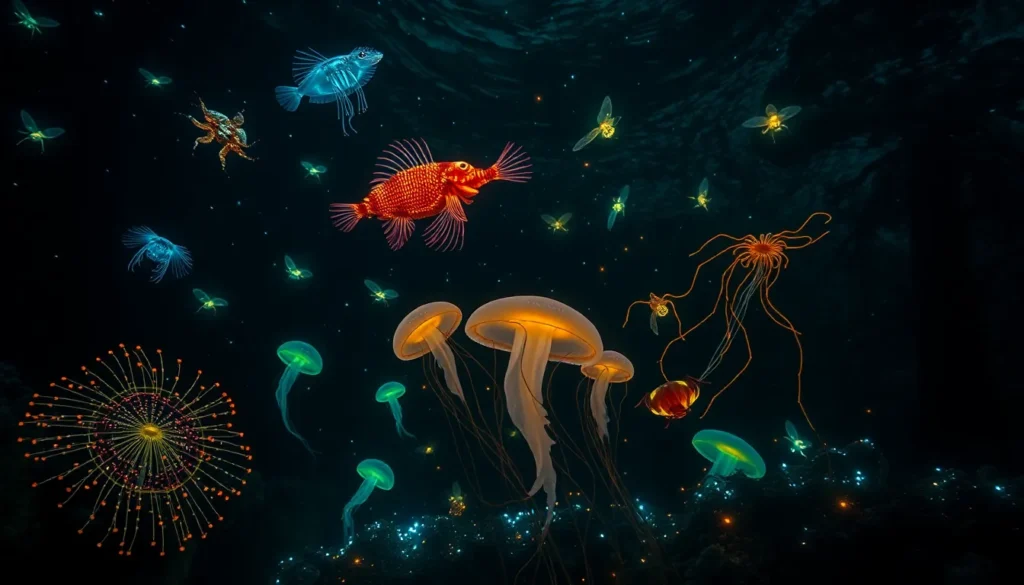
- Bioluminescence occurs in both marine and terrestrial animals. While most are marine, some terrestrial species like fireflies also exhibit it.
- Deep-sea creatures commonly use bioluminescence. It helps them survive in dark ocean depths where sunlight cannot penetrate.
- Some species use bioluminescence for camouflage. Counterillumination helps them blend with faint light from above, hiding them from predators.
- Bioluminescence aids in attracting mates. Fireflies use species-specific light patterns to communicate during courtship.
- It can function as a defense mechanism. Some squid and small crustaceans eject bioluminescent material to confuse predators.
- Not all bioluminescence is visible to the human eye. Some animals emit light in wavelengths that humans cannot see.
- Bioluminescent bacteria exist. These bacteria often live symbiotically with marine animals like anglerfish.
- Bioluminescence is energetically efficient. It produces light with very little heat loss compared to artificial lighting.
- Some jellyfish have bioluminescent capabilities. For example, the Aequorea victoria species has been studied extensively.
- Bioluminescence can be used to lure prey. Anglerfish use a glowing lure to attract smaller fish.
- Bioluminescence evolved independently multiple times. It is an example of convergent evolution across different taxa.
- Some fungi exhibit bioluminescence. Although not animals, these organisms share similar biochemical pathways.
- Bioluminescent animals vary in color. Blue and green are most common in the ocean as these wavelengths travel furthest underwater.
- The Hawaiian bobtail squid uses luminescent bacteria for camouflage. It mimics moonlight to avoid predators.
- Marine plankton can cause bioluminescent waves. Dinoflagellates emit light when disturbed by movement.
- Bioluminescent signals can be extremely fast. Some species flash light in milliseconds to communicate or startle threats.
- Bioluminescent animals often have specialized organs. Known as photophores, these structures control the light emission.
- Scientists study bioluminescence for medical research. The green fluorescent protein (GFP) from jellyfish is widely used as a marker in genetics.
- Bioluminescence is more common in oceanic animals than in freshwater species. The reasons relate to ecological factors and evolutionary pressures.
- Some predators mimic bioluminescent signals to deceive prey. This technique improves their hunting success.
Habitat and Behavior
Bioluminescent animals inhabit a wide range of environments, predominantly in marine ecosystems such as the deep ocean, coastal waters, and coral reefs. The extreme depth and darkness of the ocean favor the evolution of bioluminescence as a method of communication, predation, and defense. Terrestrial bioluminescent animals like fireflies are generally found in warm temperate and tropical environments, often in forests or grasslands where their light signals play a role in mating. Behaviorally, these animals use bioluminescence in various ways including attracting mates, deterring predators, camouflaging themselves, or luring prey. Many deep-sea species release light flashes or glowing clouds when threatened, while others actively control the intensity and pattern of their light emissions for communication.
Why This Animal Matters
Bioluminescent animals play important ecological roles, particularly in marine food webs. They contribute to predator-prey dynamics and influence species interactions through their light signaling. Their unique adaptations have fascinated scientists, leading to advances in biotechnology and medical research, notably with the discovery and application of fluorescent proteins. Culturally, some bioluminescent species have inspired myths, art, and tourism, such as glowing beaches caused by bioluminescent plankton. Conservation-wise, understanding these animals helps monitor ocean health and biodiversity, as many bioluminescent species are sensitive to environmental changes and pollution.
Common Misconceptions
Misconception: All bioluminescent animals produce light continuously.
Correction: Most bioluminescent animals control when and how they emit light, often flashing or glowing only during specific behaviors like mating or defense.
Misconception: Bioluminescence is the same as fluorescence.
Correction: Bioluminescence is light produced by a chemical reaction within an organism, whereas fluorescence involves the absorption and re-emission of external light.
Misconception: Only deep-sea creatures are bioluminescent.
Correction: While common in deep sea species, bioluminescence also occurs in terrestrial species like fireflies and some fungi.
FAQ
What causes bioluminescence in animals?
Bioluminescence results from a chemical reaction involving luciferin and the enzyme luciferase, which produces light with very little heat.
Are bioluminescent animals only found in the ocean?
No, while most bioluminescent animals live in marine environments, some terrestrial species such as fireflies also produce light.
Why do animals produce bioluminescence?
Animals use bioluminescence for various purposes including attracting mates, deterring predators, camouflaging themselves, and luring prey.

Leave a Reply