
Short Answer
21 Facts About Antlions
- Antlions belong to the family Myrmeleontidae. They are a group of insects closely related to lacewings and owlflies.
- The name “antlion” derives from their larval diet. Their larvae primarily prey on ants and other small insects.
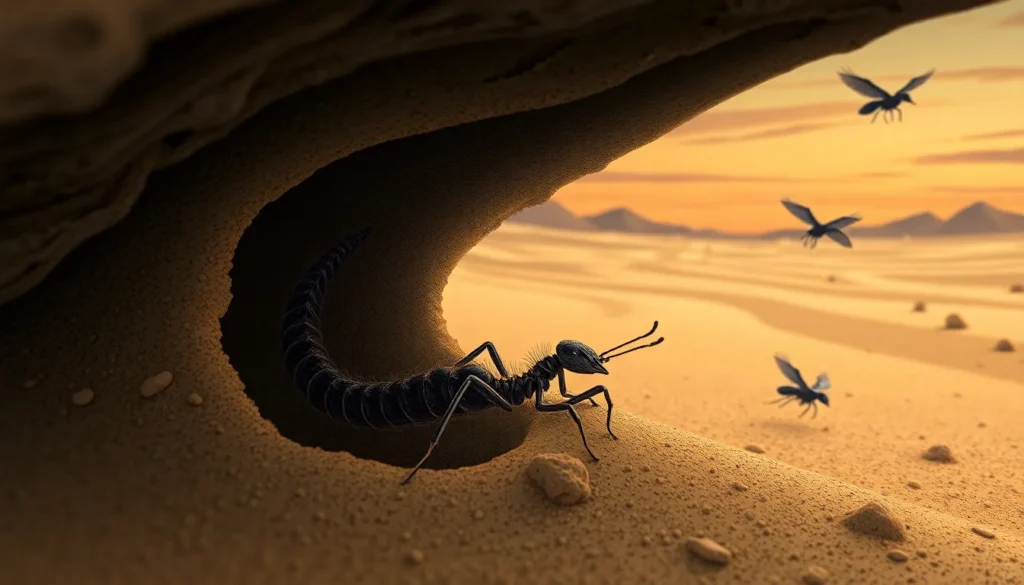
- Antlion larvae are known for creating conical pit traps. These pits in loose soil or sand trap unsuspecting prey.
- The larval stage of an antlion can last several years. This prolonged period allows them to grow and store energy before pupating.
- Adult antlions resemble dragonflies but are typically weaker fliers. They have long, slender bodies and two pairs of net-veined wings.
- Adult antlions are mostly nocturnal. They are attracted to light and tend to fly during dusk or nighttime.
- Antlion larvae have large, powerful jaws. These jaws are used to capture and immobilize prey quickly.
- The pitfall trap is an efficient hunting strategy unique among insects. Larvae flick sand to cause prey to fall deeper into the pit.
- Antlions are found worldwide, especially in warm, sandy environments. They are most common in dry, open habitats.
- Some antlion species do not build pits. These non-pit-building larvae actively hunt their prey on the ground.
- Antlions undergo complete metamorphosis. Their life cycle includes egg, larva, pupa, and adult stages.
- Adult antlions typically live only a few weeks. Their primary purpose is reproduction.
- Antlion larvae are often mistaken for dragonfly or damselfly larvae. However, their habitat and morphology differ significantly.
- Antlion pit traps can be up to several centimeters deep. The size varies depending on the species and larval growth stage.
- Larval antlions are ambush predators. They wait motionless at the bottom of their pits until prey appears.
- Antlions can flick sand at prey with remarkable precision. This behavior prevents prey from escaping the pit.
- Adult antlions do not feed extensively. Some species may consume nectar or pollen, but many rely on stored energy.
- Predators of antlions include birds, reptiles, and other larger insects. Antlions use camouflage and burying strategies for protection.
- Antlions have been subjects of scientific studies on predator-prey interactions. Their hunting methods provide insight into evolutionary adaptations.
- Fossil records show antlions have existed for millions of years. Their basic morphology has remained relatively unchanged.
- Antlions contribute to controlling insect populations. By preying on ants and other small insects, they help maintain ecological balance.
Habitat and Behavior
Antlions predominantly inhabit warm, dry environments with loose, sandy soils suitable for their larval pit-building behavior. They are found worldwide, especially in regions such as deserts, grasslands, and open woodlands. The larvae live underground or just beneath the surface, where they construct their conical pits. These pits serve as traps to capture small insects, primarily ants, that fall inside. Larvae remain motionless at the pit’s base, using their large jaws to seize prey. Adults are mostly nocturnal and are often observed near artificial lights at night. They have a weak flight compared to similar insects and tend to rest during the day. Antlions are solitary creatures, with interactions mainly occurring during mating seasons.
Why This Animal Matters
Antlions play a significant role in ecosystems as predators of small insects, thus helping regulate insect populations, including pests. Their unique hunting strategy and extended larval stage provide valuable insight into evolutionary biology and predator-prey dynamics. Culturally, antlions have inspired folklore in various societies due to their unusual behavior. From a conservation perspective, their sensitivity to habitat disturbance highlights the importance of preserving sandy and undisturbed environments. Understanding antlions contributes to broader knowledge of insect biodiversity and ecological balance.
Common Misconceptions
Misconception: Antlions are dangerous to humans.
Correction: Antlions are harmless to humans. Their jaws can only capture small insects, and they do not pose any threat.
Misconception: Adult antlions are aggressive predators.
Correction: Adult antlions rarely feed and are generally weak fliers. Their primary role is reproduction, not active predation.
Misconception: All antlion larvae build pits.
Correction: While many species do build pit traps, some antlion larvae are free-roaming hunters and do not construct pits.
FAQ
What do antlion larvae eat?
Antlion larvae primarily feed on ants and other small insects that fall into their pit traps. They use their powerful jaws to capture and immobilize their prey.
Do adult antlions build pits like larvae?
No, adult antlions do not build pits. The pit-building behavior is exclusive to the larval stage, which uses it as a hunting strategy.
Are antlions harmful to humans?
Antlions are harmless to humans. They do not bite or sting and pose no threat, as their jaws are adapted only to capture small insects.


Leave a Reply