
Short Answer
The Pyramids of Egypt, monumental marvels that have stood the test of time, stir curiosity and intrigue among historians, archaeologists, and everyday enthusiasts. These architectural giants not only serve as tombs for ancient Pharaohs but also encapsulate a myriad of enigmas that defy understanding. As we delve into the realms of astonishing facts about these enigmatic structures, we uncover a tapestry woven with history, mystery, and the unyielding quest for knowledge. Here are ten massive and mysterious weird facts about the pyramids that continue to baffle and amaze.
1. The Great Pyramid’s Alignment with Precision
The Great Pyramid of Giza, the grandest of the trio, exhibits a mathematical prowess that leaves modern architects in awe. It is aligned almost perfectly to true north, deviating by only 0.067 degrees. This remarkable precision raises questions about the ancient Egyptians’ understanding of astronomy and geometry. Was it a mere coincidence, or does it hint at lost knowledge from a civilization far ahead of its time?
2. A Hidden Passage Inside
In the labyrinthine structure of the Great Pyramid, a hidden passageway was discovered in recent years. This narrow corridor, located above the Grand Gallery, has piqued the interest of researchers. What might lie at its end? Speculation abounds regarding its purpose—was it meant to serve as a new route for the Pharaoh’s soul to ascend to the afterlife, or perhaps it holds secrets waiting to be unraveled?
3. The Enigmatic Sphinx Connection
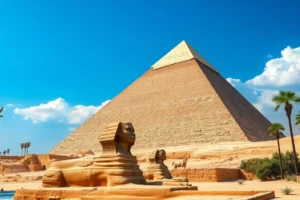
Guarding the Giza Plateau alongside its pyramidal counterparts is the Great Sphinx, a marvel in its own right. Some historians and archaeologists propose that the Sphinx was constructed prior to the pyramids, based on erosion patterns and geological studies. This hypothesis invites questions about the civilization’s timeline and the possibility of a lost epoch of human development obscured by time.
4. Astronomical Significance
The pyramids are thought to have been constructed with astronomical alignments in mind. The Three Pyramids of Giza are believed to correlate with the belt of Orion, a constellation revered by the ancient Egyptians. This alignment not only reflects their celestial beliefs but also emphasizes their profound connection to the cosmos, positioning the Pharaohs among the stars in the afterlife.
5. The Pyramids’ Construction Debate
The construction techniques employed for the pyramids remain a source of scholarly debate. While some theorize that thousands of laborers moved giant limestone and granite blocks using sledges and water lubrication, others suggest more advanced methods, such as the use of ramps or levers. The very tools and technologies that facilitated such monumental undertakings are still a tantalizing mystery.
6. Mathematical Marvels
The dimensions and proportions of the Great Pyramid demonstrate an advanced understanding of mathematics and geometry. The ratio of the pyramid’s perimeter to its height approximates the mathematical constant pi (π), a staggering realization that foretells the Egyptians’ intellect. How did they grasp such complex mathematical principles so long ago? This knowledge continues to perplex scholars.
7. Massive Workforce and Labor Conditions
Contrary to popular belief, the workforce responsible for building the pyramids was not composed of enslaved individuals but rather skilled laborers who worked under organized labor conditions. Evidence suggests that they were well-fed and housed in nearby settlements. This raises intriguing questions about the societal structure and resources of ancient Egypt—what drove these people to dedicate their lives to this monumental task?
8. The Pyrotechnic Mystery
The ancient Egyptians seemed to possess an advanced understanding of pyrotechnics, notably in their use of fire in stone masonry. Recent studies indicate that the Egyptians may have heated stone blocks in fires to weaken them, facilitating easier shaping and movement. This fire-and-stone technique adds another layer of mystery to their construction practices.
9. Unfinished Pyramids
Throughout the desert, scattered among the more famous pyramids, there exists a plethora of unfinished structures. These incomplete pyramids offer insight into the socio-political turbulence of their time. What forces led to their abandonment? Were they exploratory projects, or were they sabotaged by political unrest? Each unfinished pyramid tells tales of ambition beset by adversity.
10. Theories of Hidden Knowledge
Many enthusiasts and theorists propose the notion that the pyramids are not mere tombs but repositories of ancient knowledge, possibly even extraterrestrial origins. Such ideas ignite the imagination, blending history with science fiction. Speculations about hidden chambers, advanced technology, or secretive societies continue to tantalize those captivated by the pyramids’ mysteries.
In conclusion, the Pyramids of Egypt stand as harbingers of historical ingenuity, artistry, and perhaps the echoes of advanced knowledge lost to time. From their precise engineering to the myriad questions they pose, these colossal structures invite continued exploration and fascination. As researchers strive to decipher their secrets, the pyramids remind us that some mysteries may forever evade complete understanding, continuing to ignite our curiosity and admiration for an ancient civilization that shaped the course of history.
FAQ
What is the significance of the Great Pyramid's alignment?
The Great Pyramid of Giza is aligned almost perfectly to true north, showcasing the ancient Egyptians’ advanced understanding of astronomy and geometry.
What are the theories surrounding the construction of the pyramids?
There are various theories, including the use of sledges, ramps, and even advanced techniques like heating stone blocks for easier shaping.
Were the workers who built the pyramids enslaved?
Contrary to popular belief, evidence suggests that the workforce was composed of skilled laborers who were well-fed and housed.




Leave a Reply