
Short Answer
21 Facts About Daddy Longlegs (Harvestmen)
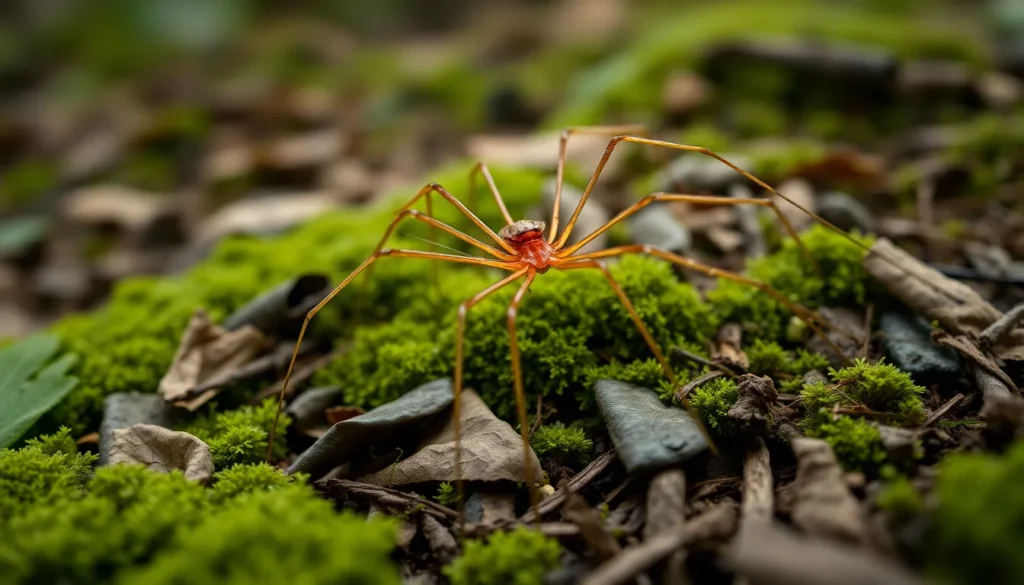
- Daddy longlegs are arachnids but not spiders. Despite their spider-like appearance, harvestmen belong to the order Opiliones, which is distinct from true spiders (order Araneae).
- They have a fused body structure. Unlike spiders, daddy longlegs have a single, fused body segment, giving them a rounded appearance.
- They possess eight long legs. Their legs are typically very long relative to their body size, which helps in sensing their environment.
- Daddy longlegs do not produce silk. Unlike spiders, harvestmen lack silk glands and cannot spin webs.
- They do not have venom glands. Harvestmen do not have venom and are harmless to humans.
- They are omnivores and scavengers. Their diet includes small insects, plant material, fungi, and decaying organic matter.
- Harvestmen communicate using chemical signals. They use pheromones to communicate, especially during mating.
- Daddy longlegs have simple eyes. Typically, they have a pair of eyes mounted on a small central structure called an ocularium.
- They have the ability to detach legs. Like some other arachnids, they can autotomize (self-amputate) legs to escape predators.
- Harvestmen exhibit parental care. Some species guard their eggs and young, which is uncommon among arachnids.
- They are found worldwide. Harvestmen occur on every continent except Antarctica, with many species adapted to diverse habitats.
- They prefer moist environments. Daddy longlegs are often found in damp places such as forests, caves, leaf litter, and under rocks.
- Harvestmen have a slow metabolism. This allows them to survive in environments with limited food resources.
- They are mostly nocturnal. Daddy longlegs are primarily active at night to avoid predators and desiccation.
- Some species exhibit aggregation behavior. They sometimes gather in large groups for protection and moisture retention.
- Harvestmen have ancient evolutionary origins. Fossil records show they have existed for at least 400 million years.
- Their long legs serve multiple functions. Legs are used for sensing, locomotion, defense, and sometimes mating rituals.
- Daddy longlegs can survive leg loss but with reduced mobility. Losing legs affects their ability to move and sense but does not usually cause death.
- They produce defensive secretions. Some species emit chemicals to deter predators.
- Harvestmen are important in ecosystems. They contribute to nutrient cycling by feeding on decomposing matter and small invertebrates.
- They are often mistaken for cellar spiders or crane flies. Despite similar common names, they are distinct animals with different biology.
Habitat and Behavior
Daddy longlegs, or harvestmen, inhabit a wide range of environments across the globe, except Antarctica. They thrive in moist, sheltered locations such as forests, caves, leaf litter, under rocks, and even urban gardens. Their preference for damp habitats helps prevent desiccation, as they are sensitive to dry conditions. Behaviorally, harvestmen are mostly nocturnal, reducing exposure to predators and harsh daytime conditions. They utilize their long legs for sensory perception, detecting vibrations and chemical cues in their surroundings. Daddy longlegs are omnivorous, feeding on small insects, plant material, fungi, and decaying organic matter, playing a valuable role in the decomposition process. Some species exhibit social behavior, forming aggregations which may assist in moisture retention and protection from predators. Reproductive behaviors include the use of pheromones for communication and, in some species, parental care where adults guard eggs until hatching.
Why This Animal Matters
Harvestmen contribute significantly to ecosystem health through their role as scavengers and predators of small invertebrates. By consuming decomposing organic material and insects, they aid nutrient cycling and help control pest populations. Their presence can indicate environmental quality, especially in forest ecosystems. Culturally, daddy longlegs have featured in folklore and myths worldwide, often surrounded by misconceptions regarding their venom and danger to humans. Understanding their biology helps dispel such myths and promotes appreciation for arachnid diversity. While generally not endangered, habitat loss and pollution can impact local populations, making awareness important for conservation efforts.
Common Misconceptions
Misconception: Daddy longlegs are the most venomous spiders but cannot bite humans.
Correction: Daddy longlegs are not spiders and do not have venom glands, so they cannot be venomous or dangerous to humans.
Misconception: Daddy longlegs spin webs.
Correction: Harvestmen do not produce silk and therefore cannot spin webs.
Misconception: Daddy longlegs are a single species.
Correction: Daddy longlegs refers to many species within the order Opiliones, which are diverse and widespread.
Misconception: They can bite humans.
Correction: Harvestmen lack venom and have small mouthparts unsuitable for biting humans.
Misconception: Daddy longlegs are harmful pests.
Correction: They are harmless and beneficial by controlling insect populations and recycling organic matter.
FAQ
Are daddy longlegs spiders?
No, daddy longlegs belong to the order Opiliones and are distinct from spiders (order Araneae). Although they are arachnids, they differ in body structure and lack venom and silk glands.
Do daddy longlegs have venom?
Harvestmen do not possess venom glands and are harmless to humans. The myth that they are highly venomous but unable to bite is incorrect.
Where do daddy longlegs live?
Daddy longlegs are found worldwide, often in moist and sheltered environments such as forests, caves, leaf litter, and under rocks.
Leave a Reply