
Short Answer
21 Facts About Moon Jellyfish
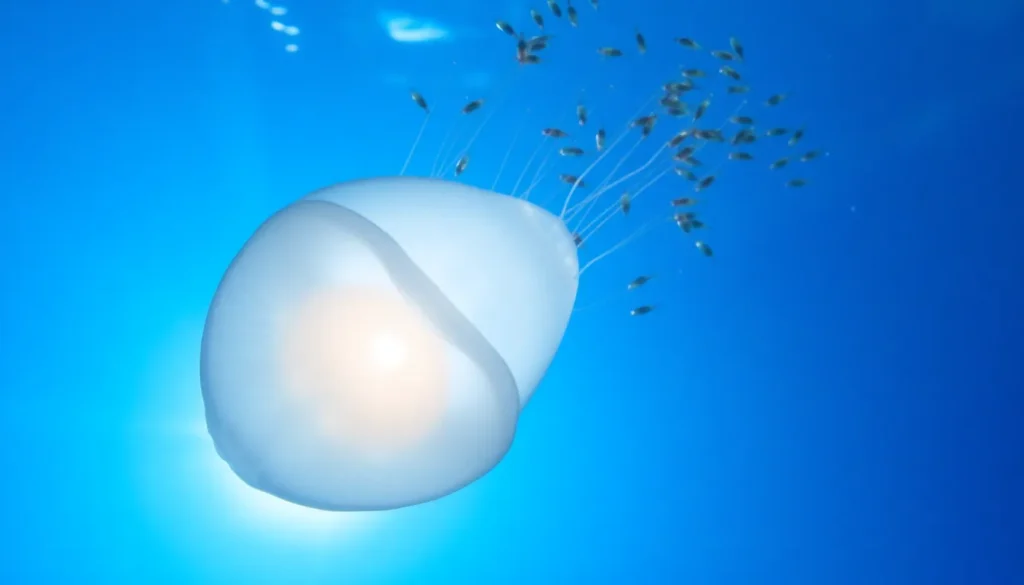
- Scientific Classification: Moon jellyfish belong to the species Aurelia aurita, a member of the class Scyphozoa within the phylum Cnidaria.
- Appearance: They have a translucent, saucer-shaped bell typically 25–40 cm in diameter with four horseshoe-shaped gonads visible through the bell.
- Global Distribution: Moon jellyfish are found in coastal waters worldwide, from tropical to temperate zones, including the Atlantic, Pacific, and Indian Oceans.
- Bioluminescence: While not strongly bioluminescent, some populations can produce faint light under certain conditions.
- Movement: They propel themselves through rhythmic contractions of their bell, allowing slow, gentle pulsations through the water.
- Diet: Moon jellyfish primarily feed on plankton, including small fish eggs, larvae, and other microscopic organisms by filtering water through their tentacles.
- Stinging Cells: Their tentacles contain nematocysts used to sting and capture prey, but their sting is generally mild and harmless to humans.
- Reproduction: They have a complex life cycle involving both sexual reproduction (medusa stage) and asexual reproduction (polyp stage).
- Lifecycle Stages: The medusa is the adult jellyfish form, while the polyp is a small, sessile stage that can produce new medusae asexually.
- Sensory Organs: Moon jellyfish have simple eyes called rhopalia along their bell margins to detect light and orientation.
- Longevity: Their lifespan in the wild is typically about six months to one year, depending on environmental factors.
- Predators: They are preyed upon by sea turtles, larger jellyfish species, some fish, and seabirds.
- Population Fluctuations: Their populations can bloom in response to environmental conditions like water temperature and nutrient availability.
- Role in Food Webs: Moon jellyfish serve as both predators of plankton and prey for larger marine species, playing an important role in marine ecosystems.
- Environmental Indicators: Their population changes can indicate shifts in marine environmental health, such as overfishing or pollution.
- Low Metabolic Rate: They have a low energy requirement, allowing survival in nutrient-poor waters.
- Transparency: Their transparent bodies offer camouflage from predators in open water.
- Temperature Tolerance: They can tolerate a wide range of temperatures but prefer temperate coastal waters.
- Impact on Human Activities: Large blooms may clog fishing nets, damage aquaculture, or interfere with power plant water intakes.
- Scientific Research: Moon jellyfish are model organisms in studies of jellyfish biology, regeneration, and aquatic ecology.
- Cultural References: Due to their ethereal appearance, they are often featured in art, literature, and aquarium exhibits worldwide.
Habitat and Behavior
Moon jellyfish inhabit coastal and estuarine waters worldwide, often found near the surface to depths of about 20 meters. They prefer temperate zones but can also be found in warm and cold waters, demonstrating broad environmental tolerance. These jellyfish drift with ocean currents and use gentle pulsations of their bell to navigate and maintain position. They tend to aggregate in large groups, sometimes forming blooms, particularly when food sources are abundant. Moon jellyfish feed primarily at night, capturing planktonic organisms with their tentacles. Their simple sensory structures help them detect light and orient themselves but do not enable complex navigation. They avoid predators mainly through their semi-transparency and mild stinging ability.
Why This Animal Matters
Moon jellyfish contribute significantly to marine food webs by consuming plankton and serving as prey for a variety of species, including sea turtles and certain fish. Their population dynamics can reflect changes in marine ecosystems, such as nutrient levels and human impacts like overfishing. As a common and widespread jellyfish, they are important subjects in ecological and biological research, helping scientists understand cnidarian physiology, regeneration, and marine biodiversity. Additionally, moon jellyfish have cultural significance in many societies, symbolizing the mysterious and delicate aspects of ocean life. Despite their ecological importance, moon jellyfish are sensitive to environmental changes, making them indicators for monitoring ocean health.
Common Misconceptions
Misconception: Moon jellyfish have dangerous stings that can harm humans.
Correction: While moon jellyfish do have stinging cells, their sting is typically mild and causes little to no harm to humans, often resulting only in minor irritation.

Misconception: Moon jellyfish are fish.
Correction: Despite their name, moon jellyfish are not fish; they are gelatinous invertebrates belonging to the phylum Cnidaria.
Misconception: Jellyfish are simple animals without complex life cycles.
Correction: Moon jellyfish have a complex life cycle including both sexual medusa and asexual polyp stages, demonstrating biological complexity.
Misconception: Jellyfish blooms always indicate environmental problems.
Correction: While blooms can be linked to factors like nutrient pollution, they can also occur naturally due to favorable conditions and are part of normal ecological dynamics.
Misconception: Moon jellyfish are solitary creatures.
Correction: Moon jellyfish often form large aggregations or blooms, which can number in the thousands or more.
FAQ
Are moon jellyfish dangerous to humans?
Moon jellyfish possess stinging cells, but their sting is mild and typically causes only minor irritation or no reaction in humans.
How do moon jellyfish reproduce?
Moon jellyfish have a complex lifecycle involving sexual reproduction in the medusa stage and asexual reproduction during the polyp stage.
Where can moon jellyfish be found?
They are found in coastal waters worldwide, including temperate, tropical, and some colder regions, often near the ocean surface.




Leave a Reply