
Short Answer
21 Facts About Tree Pythons
- Arboreal Lifestyle
Tree pythons are primarily arboreal, spending most of their time in trees rather than on the ground. This adaptation helps them hunt and avoid predators. - Species Diversity
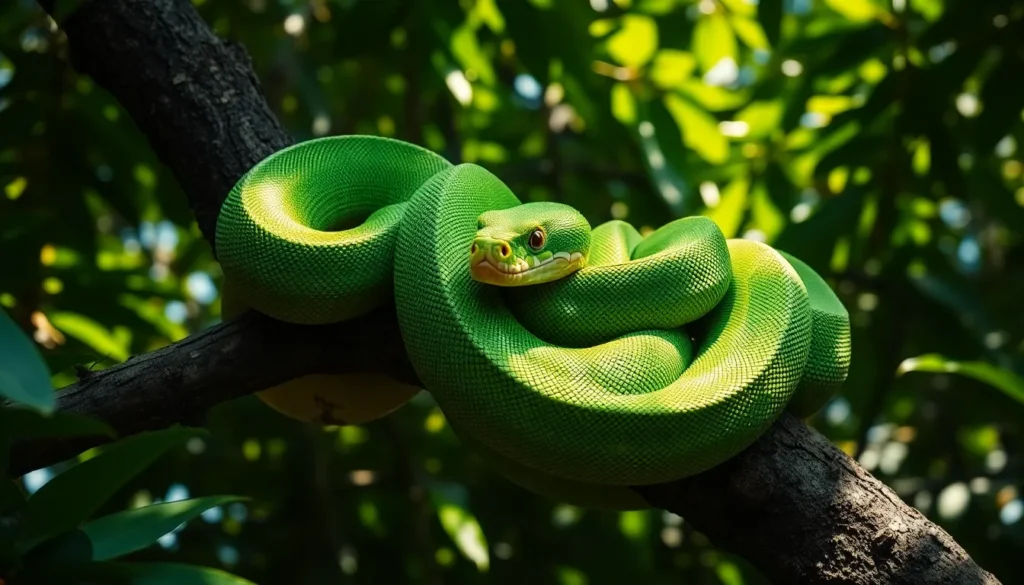
There are several species classified as tree pythons, with Morelia viridis (green tree python) and Morelia azurea (azure python) being among the most well-known. - Vibrant Coloration
Many tree pythons exhibit bright green, yellow, or blue colors which provide camouflage among foliage. - Prehensile Tail
Their tails are prehensile, allowing them to grasp branches securely while navigating through trees. - Size Range
Tree pythons typically range from 4 to 7 feet (1.2 to 2.1 meters) in length, varying by species. - Diet
They primarily feed on small mammals, birds, and reptiles, capturing prey with a constriction method. - Heat Sensing
Like many pythons, some tree pythons possess heat-sensing pits that help detect warm-blooded prey in low light. - Reproduction
Tree pythons are oviparous, laying eggs that females often incubate by coiling around them to regulate temperature. - Molting
These snakes regularly shed their skin to allow for growth and to remove parasites. - Habitat Range
They are native primarily to New Guinea, northern Australia, and some surrounding islands. - Camouflage Strategy
Their coloration can change as juveniles mature, often starting with yellow or red hues before turning green. - Behavioral Patterns
Tree pythons are mostly nocturnal hunters, using stealth and ambush tactics. - Non-Venomous
These snakes are non-venomous constrictors, relying on their strength to subdue prey. - Longevity
In captivity, tree pythons can live over 15 years, though lifespan in the wild may vary. - Movement
Despite their arboreal nature, they are capable of moving on the ground but prefer the trees. - Thermoregulation
They often bask in sunlight to regulate body temperature, especially after feeding. - Predators
Natural predators include birds of prey and larger reptiles, though their arboreal habits offer some protection. - Conservation Status
While some species are common, habitat destruction poses a threat to certain populations. - Ecological Role
Tree pythons help control populations of rodents and other small animals, maintaining ecological balance. - Captive Care
They are popular in the exotic pet trade but require specialized care due to their arboreal and temperature needs. - Scientific Study
Research on tree pythons contributes to understanding evolutionary adaptations of arboreal snakes.
Habitat and Behavior
Tree pythons inhabit tropical rainforests and woodlands, primarily in New Guinea and northern Australia. Their arboreal lifestyle means they spend much of their time in the canopy and mid-level branches of trees, where their coloration provides effective camouflage. They are mostly nocturnal, hunting at night using stealth to capture birds, mammals, and reptiles. Their prehensile tails assist in climbing and stabilizing their bodies while navigating through branches. During the day, they often rest coiled on tree limbs or in foliage. Reproduction involves females laying eggs in secure locations, which they then incubate by coiling around them to maintain optimal temperature. In their natural environment, tree pythons play a crucial role as mid-level predators.
Why This Animal Matters
Tree pythons contribute significantly to the ecological balance of their habitats by controlling populations of small mammals and birds. This predation helps prevent overpopulation and potential damage to vegetation. Their presence indicates a healthy ecosystem, particularly in rainforest environments. Culturally, tree pythons have been subjects of fascination in indigenous folklore and are studied by scientists for their unique arboreal adaptations. Conservation efforts are important as habitat loss due to logging and land conversion threatens some populations. Maintaining healthy tree python populations supports biodiversity and the integrity of tropical forest ecosystems.
Common Misconceptions
Misconception: Tree pythons are venomous and dangerous to humans.
Correction: Tree pythons are non-venomous constrictors. They subdue prey through constriction and are generally not aggressive toward humans unless provoked.

Misconception: Tree pythons can live comfortably on the ground.
Correction: While they can move on the ground, tree pythons are primarily arboreal and rely on trees for shelter, hunting, and protection.
Misconception: All tree pythons stay green throughout their lives.
Correction: Many species undergo color changes as they mature, with juveniles often displaying different colors like yellow or red before turning green.
Misconception: Tree pythons are solitary and never interact.
Correction: While generally solitary, tree pythons may interact during mating seasons and sometimes share overlapping territories.
FAQ
Are tree pythons venomous?
No, tree pythons are non-venomous snakes that kill their prey by constriction.
Where do tree pythons live?
Tree pythons primarily inhabit tropical rainforests in New Guinea, northern Australia, and nearby islands.
How do tree pythons hunt?
They are nocturnal ambush predators that use stealth and their heat-sensing abilities to locate and constrict prey such as birds and small mammals.

Leave a Reply