
Short Answer
21 Facts About Animal Speed Records
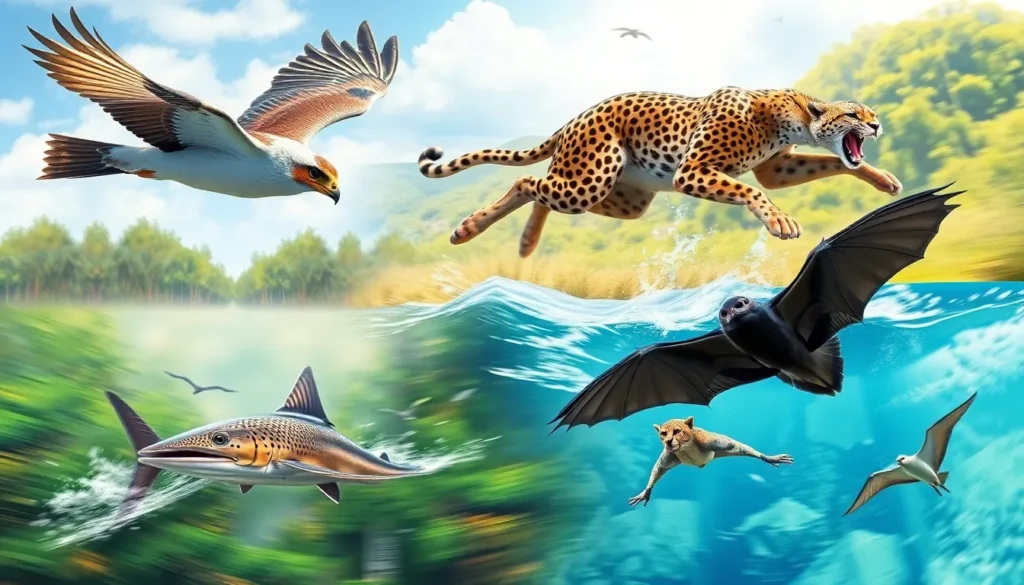
- The Peregrine Falcon is the fastest animal in the world. During its hunting dive, called a stoop, it can reach speeds over 240 mph (386 km/h), making it the fastest recorded animal speed.
- The Cheetah holds the land speed record. It can run up to 60-70 mph (97-113 km/h) in short bursts covering distances up to 1,500 feet, using its flexible spine and powerful limbs.
- The Sailfish is the fastest fish. It can swim at speeds up to 68 mph (110 km/h), aided by its streamlined body and retractable sail-like dorsal fin.
- The Brazilian Free-Tailed Bat is among the fastest flying mammals. It can reach speeds of approximately 99 mph (160 km/h), faster than many birds.
- The Pronghorn Antelope is the second-fastest land animal. It can sustain speeds of 55 mph (88 km/h) for long distances due to its efficient respiratory system.
- The Mexican Free-Tailed Bat has recorded high speeds. Its flight speed rivals that of some birds, reaching up to 99 mph (160 km/h) in level flight.
- The Greyhound is the fastest dog breed. It can reach speeds around 45 mph (72 km/h), used primarily for hunting and racing.
- The African Elephant can run surprisingly fast. Despite its size, it can reach speeds of up to 25 mph (40 km/h) in short bursts.
- The Spur-Winged Goose is one of the fastest birds in level flight. It can fly at speeds up to 88 mph (142 km/h), faster than many raptors.
- The Kangaroo Rat can leap at remarkable speeds. Though not known for running speed, it uses rapid jumps reaching 10 mph (16 km/h) to evade predators.
- The Swordfish is also a notably fast swimmer. It can swim at speeds around 60 mph (97 km/h), using its long, flat bill to slash through water efficiently.
- The Lion can sprint up to 50 mph (80 km/h) briefly. This speed helps it ambush prey during hunts but cannot be maintained for long distances.
- The Ostrich is the fastest bird on land. It can run up to 45 mph (72 km/h) using its long legs and powerful muscles.
- The Dragonfly is one of the fastest insects in flight. Some species have been recorded flying at speeds of up to 36 mph (58 km/h).
- The Blue Wildebeest can run at speeds up to 50 mph (80 km/h). This speed aids in migration and escaping predators across African plains.
- The Marlin is another fast-swimming fish. It can reach speeds around 50 mph (80 km/h), using its pointed snout and streamlined body for efficient swimming.
- The Grey-headed Albatross can glide at high speeds. It can reach speeds of approximately 79 mph (127 km/h) using wind currents during flight over oceans.
- The Jackrabbit is one of the fastest small mammals. It can run up to 45 mph (72 km/h) using strong hind legs to evade predators.
- The Black Marlin is often cited as one of the fastest fish. It can reportedly swim at speeds exceeding 80 mph (129 km/h), though exact measurements vary.
- The Elk can run up to 45 mph (72 km/h). This speed allows it to flee from predators in forest and mountainous habitats.
- The Dragonfly’s rapid wing beats contribute to its speed. It can move each wing independently, enabling sudden bursts of speed and agile maneuvering.
Habitat and Behavior
Animals that hold speed records inhabit diverse environments, from open plains and forests to oceans and skies. Land speedsters like the cheetah and pronghorn inhabit grasslands and savannas where open space allows for rapid sprints. Birds and bats achieve high speeds through specialized wing structures and flight patterns, often in open airspaces or coastal regions. Aquatic speed champions such as sailfish and marlin inhabit warm ocean waters, relying on streamlined bodies and powerful muscles to rapidly chase prey or evade predators. High-speed adaptations often relate to survival strategies including hunting, escaping threats, and migration. These animals exhibit behaviors like short bursts of acceleration, aerodynamic body shapes, and specialized muscle fibers to optimize speed.
Why This Animal Matters
Animals with remarkable speed records play critical ecological roles. Predators like the cheetah and peregrine falcon regulate prey populations, maintaining balanced ecosystems. Fast swimmers such as marlins influence marine food chains by preying on smaller fish and invertebrates. Their speed adaptations also inspire scientific research in biomechanics and robotics, contributing to technological advances. Moreover, many fast animals hold cultural significance, symbolizing agility, power, and freedom in human societies. Conservation of these animals is essential, as habitat loss and human activities threaten their populations, impacting ecosystem stability and biodiversity.
Common Misconceptions
Misconception: The cheetah is the fastest animal overall.
Correction: While the cheetah is the fastest land animal, the peregrine falcon surpasses it in speed during its hunting dives.
Misconception: Elephants cannot run due to their size.
Correction: Elephants can run at speeds up to 25 mph (40 km/h) in short bursts despite their large mass.
Misconception: All fast-flying animals rely solely on wing flapping.
Correction: Many birds and bats use gliding and soaring techniques to achieve high speeds with less energy expenditure.
FAQ
What is the fastest animal in the world?
The peregrine falcon is the fastest animal, reaching speeds over 240 mph (386 km/h) during its hunting dive.
How fast can a cheetah run?
A cheetah can run between 60-70 mph (97-113 km/h) in short bursts covering distances up to 1,500 feet.
Why do some animals need to be so fast?
Speed helps animals escape predators, catch prey, and sometimes migrate efficiently, which are essential for survival and reproduction.

Leave a Reply