
Short Answer
21 Facts About Caecilians
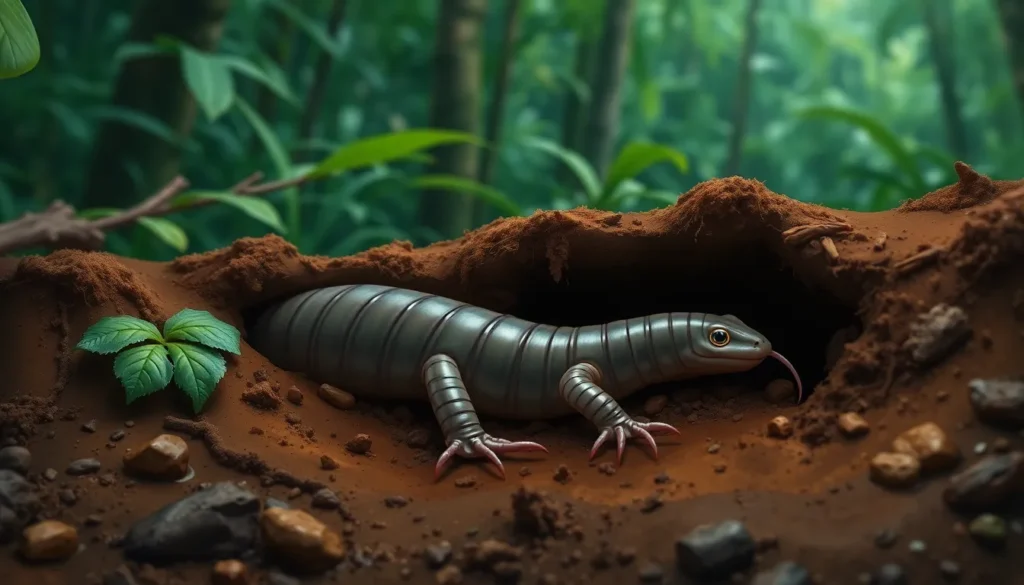
- Caecilians are limbless amphibians. Unlike frogs and salamanders, caecilians have elongated, worm-like bodies without limbs, which aid in their burrowing lifestyle.
- They belong to the order Gymnophiona. This is one of the three main orders of amphibians, alongside Anura (frogs) and Caudata (salamanders).
- Caecilians have a unique skull structure. Their skulls are heavily ossified to help them push through soil and underground debris efficiently.
- Most caecilians are burrowers. They spend much of their lives underground, which makes them difficult to study and contributes to their relative obscurity.
- They have sensory tentacles. Located between their eyes and nostrils, these tentacles help detect chemical cues in the environment, compensating for their often-reduced eyesight.
- Caecilian eyes are usually small or covered by skin. Due to their subterranean habits, their vision is limited and not their primary sensory modality.
- They are found primarily in tropical regions. Caecilians inhabit moist soil in tropical Africa, Asia, and Central and South America.
- Their skin contains ring-like folds called annuli. These segments give them a segmented appearance similar to earthworms but are distinct from true segmentation.
- Caecilians possess a unique reproductive mode. Some species lay eggs, while others give birth to live young, exhibiting both oviparity and viviparity within the group.
- Parental care is common among caecilians. In some species, mothers provide nutrients to their young by allowing them to feed on their skin in a process called dermatophagy.
- They have a specialized jaw-closing mechanism. This adaptation enhances their ability to capture prey underground.
- Caecilians primarily feed on invertebrates. Their diet includes earthworms, termites, and other small soil-dwelling animals.
- They have a reduced or absent tail. This differs from salamanders, which typically have visible tails.
- Caecilians have a bilateral body plan but lack external segmentation. Their internal anatomy shows some segmentation, especially in muscles and vertebrae.
- They secrete mucus to aid in burrowing. This secretion helps reduce friction as they move through soil.
- Caecilians are often mistaken for snakes or worms. Their limbless, elongated bodies can cause confusion, but they are amphibians, not reptiles or annelids.
- The fossil record of caecilians is sparse. Due to their soft bodies and burrowing habits, fossils are rare and often fragmentary.
- Some species possess venom glands. These glands likely assist in subduing prey but are not well studied.
- Caecilians play a role in soil health. By burrowing, they aerate the soil and contribute to nutrient cycling in their ecosystems.
- There are about 200 known species of caecilians. Ongoing research continues to discover new species, especially in understudied tropical regions.
- They have a unique evolutionary history. Molecular studies suggest caecilians diverged from other amphibians over 250 million years ago, representing an ancient lineage.
Habitat and Behavior
Caecilians predominantly inhabit moist tropical environments where the soil is soft enough to support their burrowing lifestyle. They are found in regions of South and Central America, Africa, and parts of South and Southeast Asia. Their fossorial (burrowing) behavior allows them to avoid predators and extreme environmental conditions. Caecilians use their strong, compact skulls to push through soil and leaf litter, and their ringed skin helps maintain flexibility. They spend much of their lives underground but can occasionally be found in aquatic or semi-aquatic environments, depending on the species. Caecilians feed mainly on small invertebrates such as earthworms and termites, using chemical cues detected by their tentacles to locate prey. Reproduction varies, with some species laying eggs in moist soil or water, while others bear live young. Parental care, including the feeding of young via skin secretions, is a notable behavior in some species.
Why This Animal Matters
Caecilians contribute significantly to soil ecosystems by aerating and mixing the soil through their burrowing activities, which promotes nutrient cycling and supports plant growth. Their role as predators of invertebrates helps regulate soil invertebrate populations, maintaining ecological balance. Despite their elusive nature, caecilians are an important part of amphibian biodiversity and evolutionary history, representing a unique branch of amphibian evolution. Conservation of caecilian species is crucial as many face threats from habitat destruction, pollution, and climate change, yet their secretive habits make assessing their conservation status challenging. Additionally, studying caecilians can provide insights into amphibian biology, evolution, and adaptations to subterranean life.
Common Misconceptions
Misconception: Caecilians are snakes or worms.
Correction: Although they resemble snakes or worms due to their limbless, elongated bodies, caecilians are amphibians, not reptiles or annelids. They belong to a distinct order with unique anatomical and reproductive traits.

Misconception: All amphibians have legs.
Correction: While most amphibians like frogs and salamanders have legs, caecilians are an exception as they are limbless, adapted for life underground.
Misconception: Caecilians are widespread and commonly encountered.
Correction: Caecilians are generally elusive and rarely seen due to their subterranean habits, making them less well-known and less studied than other amphibians.
Misconception: Caecilians are harmful to humans.
Correction: Caecilians are not venomous to humans and pose no significant threat. Their secretive nature means they rarely come into contact with people.
FAQ
What are caecilians?
Caecilians are a group of limbless, burrowing amphibians characterized by their elongated bodies and subterranean lifestyle.
Where do caecilians live?
Caecilians primarily inhabit moist tropical soils in regions across Africa, Asia, and Central and South America.
How do caecilians reproduce?
Caecilians exhibit diverse reproductive strategies, including laying eggs (oviparity) and giving birth to live young (viviparity), with some species providing parental care through skin feeding.


Leave a Reply