
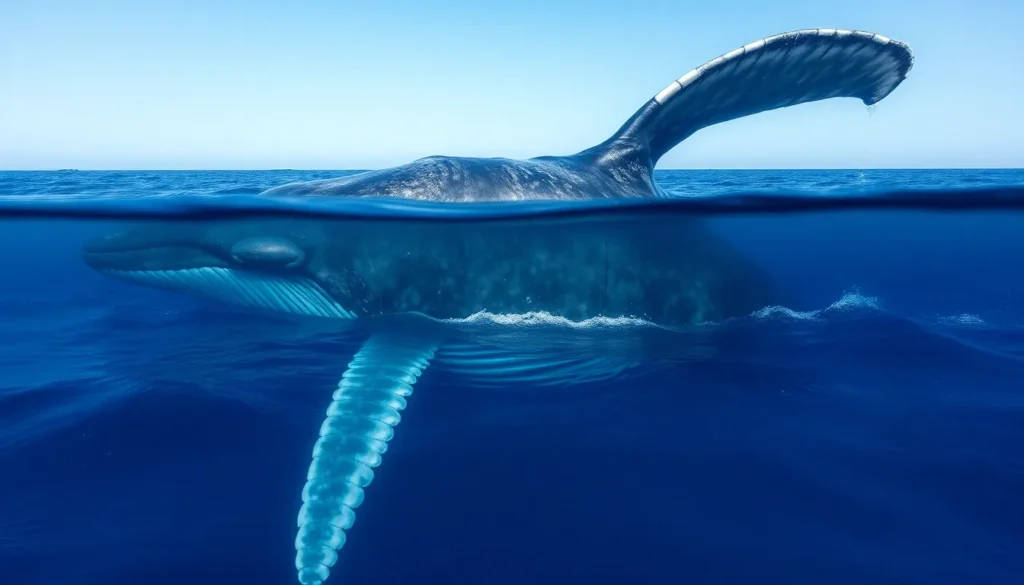
Short Answer
21 Facts About the Blue Whale
- The Largest Animal Ever: The blue whale (Balaenoptera musculus) is the largest animal known to have ever existed, surpassing even the largest dinosaurs in size.
- Massive Size: Adult blue whales can reach lengths of up to 100 feet (30 meters) and weigh as much as 200 tons (approximately 181 metric tonnes).
- Heart Size: The blue whale’s heart is the largest of any animal, weighing around 400 pounds (180 kilograms) and comparable in size to a small car.
- Diet Primarily Krill: Despite their immense size, blue whales feed almost exclusively on tiny shrimp-like animals called krill, consuming up to 4 tons in a day during feeding season.
- Feeding Mechanism: Blue whales are baleen whales; they use baleen plates to filter krill from seawater, a feeding strategy known as lunge feeding.
- Global Distribution: Blue whales are found in all the world’s oceans, from the Arctic to the Southern Ocean, typically migrating between feeding and breeding grounds annually.
- Longevity: They can live for 70 to 90 years, with some individuals possibly reaching over 100 years of age.
- Call Volume: Blue whales produce some of the loudest sounds of any animal, with calls reaching up to 188 decibels, which can travel hundreds of miles underwater.
- Reproduction: Female blue whales give birth to a single calf after an 11-month gestation period; calves can weigh around 3 tons at birth.
- Swimming Speed: Despite their size, blue whales can swim at speeds of up to 20 miles per hour (32 kilometers per hour) in short bursts.
- Blowhole Spray: Their blow or spout can reach heights of up to 30 feet (9 meters), visible from a great distance at the ocean’s surface.
- Skin Appearance: Their skin is typically a bluish-gray color, often mottled with lighter spots, which can appear blue underwater.
- Population Decline: Blue whales were severely hunted during the 20th century, leading to drastic population declines; today they are considered endangered.
- Conservation Status: International protections and whaling bans have helped blue whale populations slowly recover, but they remain vulnerable to ship strikes and entanglement.
- Size Variation: There are several subspecies of blue whales, with slight variations in size and habitat preferences, including the Antarctic blue whale, the largest subspecies.
- Metabolic Rate: Blue whales have a high metabolic rate to support their massive bodies and energetic migrations.
- Role in Ocean Ecosystem: Through their feeding and nutrient cycling, blue whales contribute significantly to ocean productivity and carbon cycling.
- Social Behavior: Blue whales are generally solitary or found in small groups, with limited social interaction compared to some other whale species.
- Migration Patterns: They perform long migratory journeys between polar feeding grounds and tropical or subtropical breeding grounds annually.
- Historical Significance: Blue whales have been subjects of human fascination and study for centuries, symbolizing the majesty and mystery of marine life.
- Scientific Research: Modern research utilizes acoustic monitoring, satellite tracking, and genetic studies to better understand blue whale biology and aid conservation efforts.
Habitat and Behavior
Blue whales inhabit all the world’s oceans, thriving primarily in deep offshore waters rather than coastal areas. They favor regions with abundant krill populations, which are often found in cold, nutrient-rich waters such as those near the poles during summer months. Blue whales undertake extensive seasonal migrations, traveling thousands of miles between feeding areas in polar regions during summer and breeding grounds in warmer tropical or subtropical waters during winter. Their behavior is generally solitary or in small, loose aggregations. Blue whales communicate using low-frequency vocalizations that can travel across great distances underwater, which is believed to facilitate mating and social interactions. Their feeding strategy involves lunge-feeding, where they accelerate toward dense krill swarms, engulf large volumes of water, and filter the prey using baleen plates. Despite their size, they are agile swimmers, capable of reaching speeds of up to 20 miles per hour for short periods.
Why This Animal Matters
Blue whales play a crucial ecological role in marine environments. By consuming vast amounts of krill, they help regulate prey populations and maintain balance within ocean ecosystems. Their vertical movements during feeding and migration contribute to nutrient cycling, often referred to as the “whale pump,” which enhances primary productivity in surface waters. Culturally, blue whales have long inspired awe and respect, featuring in indigenous lore, literature, and modern environmental movements. From a conservation perspective, blue whales serve as flagship species for marine protection efforts due to their sensitivity to human impacts such as ship strikes, noise pollution, and climate change. Protecting blue whales also helps safeguard broader marine biodiversity and promotes healthy ocean ecosystems.
Common Misconceptions
Misconception: Blue whales are dangerous to humans.
Correction: Blue whales are gentle giants that pose no threat to humans. They are filter feeders that consume tiny krill and typically avoid close contact with people.
Misconception: Blue whales are found only in cold waters.
Correction: While blue whales feed in cold, nutrient-rich polar waters, they migrate to warmer tropical and subtropical regions for breeding and calving.
Misconception: Blue whales are slow and cumbersome due to their size.
Correction: Despite their massive size, blue whales can swim at impressive speeds of up to 20 miles per hour in short bursts and are highly agile in the water.
FAQ
How big is the blue whale compared to other animals?
The blue whale is the largest animal ever known to have existed, surpassing the size of any known dinosaur, with lengths up to 100 feet and weights around 200 tons.
What do blue whales eat?
Blue whales primarily feed on krill, small shrimp-like creatures. They consume several tons of krill daily during feeding seasons using baleen plates to filter them from seawater.
Are blue whales endangered?
Yes, blue whales are classified as endangered due to historic whaling that drastically reduced their numbers. Though populations are recovering slowly under international protection, they remain vulnerable to threats such as ship strikes and habitat disturbance.





Leave a Reply