
Short Answer
21 Facts About Water Striders
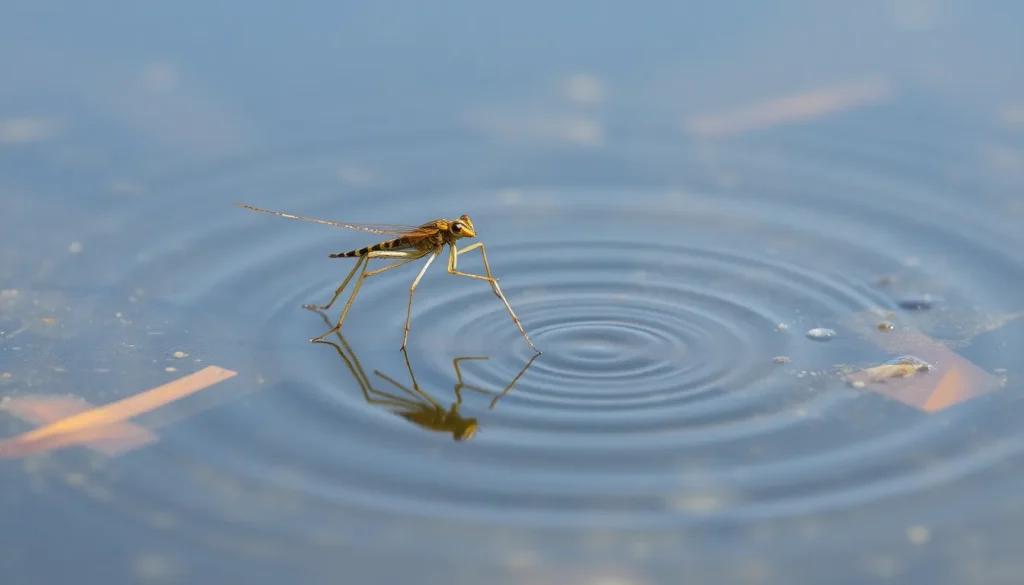
- Water striders can walk on water. They use surface tension and specialized hydrophobic hairs on their legs to stay afloat and move across water surfaces without sinking.
- They belong to the family Gerridae. Water striders are true bugs classified in the order Hemiptera, family Gerridae.
- They have long, slender legs. Their legs are adapted to distribute their weight evenly to avoid breaking the water surface.
- Water striders detect prey through water ripples. They sense vibrations caused by trapped insects or other small creatures on the water surface.
- They primarily feed on insects fallen into water. Water striders prey on insects trapped on or near the water, such as mosquitoes and flies.
- They use their middle legs for rowing. The middle legs act like oars, propelling them efficiently on water.
- Water striders have a unique grooming behavior. They clean their legs regularly to maintain the hydrophobic properties essential for walking on water.
- They can jump to escape predators. Water striders can leap off the water surface to avoid threats.
- Some species exhibit parental care. In certain species, males guard eggs laid on vegetation near water.
- Water striders communicate using ripple signals. They generate and interpret water surface waves to interact with each other.
- They are found worldwide. Water striders inhabit freshwater bodies on every continent except Antarctica.
- They can move rapidly on water. Some species can reach speeds up to 1 meter per second.
- Water striders’ legs are covered with microscopic hairs. These hairs trap air and repel water, enhancing buoyancy and preventing wetting.
- They exhibit sexual dimorphism. Males and females can differ in size and leg length, depending on the species.
- Water striders play a role in aquatic food webs. They act as predators controlling insect populations on water surfaces.
- They have been studied for biomimicry applications. Their locomotion and leg structures inspire the design of water-walking robots.
- Water striders breathe air. They do not live underwater but rely on atmospheric oxygen.
- They can survive in various freshwater environments. Including ponds, streams, lakes, and calm river edges.
- Water striders are sensitive to water pollution. Their presence often indicates a healthy aquatic ecosystem.
- They have existed since at least the Jurassic period. Fossil evidence suggests water striders have a long evolutionary history.
- Water striders can sometimes be mistaken for spiders. Due to their appearance and surface movement, but they are insects, not arachnids.
Habitat and Behavior
Water striders are primarily found on the surfaces of freshwater bodies such as ponds, lakes, streams, and slow-moving rivers worldwide, except in Antarctica. They thrive in calm water environments where surface tension allows them to move easily. Their behavior revolves around walking or skating on water surfaces using their long, hydrophobic legs. Water striders are predatory insects that detect prey through vibrations on the water surface, feeding mainly on insects trapped in or fallen onto the water. They communicate through ripple signaling and can rapidly escape predators by jumping off the water surface. Some species demonstrate parental care by guarding eggs laid near water.
Why This Animal Matters
Water striders play an important ecological role as predators in freshwater ecosystems, helping control populations of insects such as mosquitoes and flies. Their presence is often a sign of good water quality, making them useful bioindicators for environmental monitoring. Additionally, water striders have attracted scientific interest in biomechanics and biomimicry due to their unique ability to move on water, inspiring advances in robotics. Their evolutionary history and widespread distribution contribute to freshwater biodiversity and ecosystem stability.
Common Misconceptions
Misconception: Water striders are spiders.
Correction: Despite their spider-like appearance and movement on water, water striders are insects in the family Gerridae, not arachnids.
Misconception: Water striders live underwater.
Correction: Water striders live on the water surface and breathe atmospheric oxygen; they do not dive or live submerged.
Misconception: Water striders can walk on all types of water.
Correction: They require relatively calm water with intact surface tension; turbulent or polluted water can prevent their movement.
FAQ
How do water striders walk on water?
Water striders walk on water by using the surface tension of the water combined with specialized hydrophobic hairs on their legs that repel water and distribute their weight evenly to prevent sinking.
What do water striders eat?
Water striders primarily feed on insects and other small arthropods that fall onto or become trapped on the surface of water.
Are water striders harmful to humans?
No, water striders are harmless to humans. They do not bite or transmit diseases and are beneficial predators in aquatic ecosystems.

Leave a Reply