
Short Answer
21 Facts About Bats
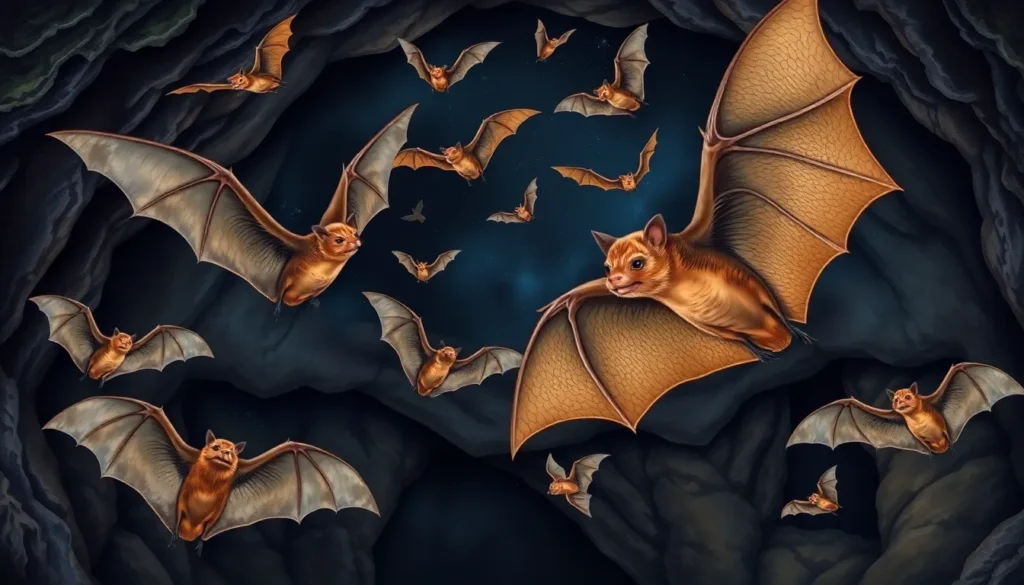
- Bats are the only mammals capable of sustained flight. Unlike flying squirrels or gliding mammals, bats have wings formed by a thin membrane stretched over elongated finger bones.
- There are over 1,400 species of bats worldwide. They are found on every continent except Antarctica, with species adapted to diverse environments.
- Bats use echolocation to navigate and hunt. They emit high-frequency sounds that bounce off objects, allowing them to ‘see’ their surroundings in the dark.
- Not all bats use echolocation. Fruit bats, also called flying foxes, generally rely on keen eyesight and smell instead of echolocation.
- Bats play a critical role in insect control. Many insectivorous bats consume large quantities of insects nightly, helping to control pest populations.
- Some bats are important pollinators. Species like the lesser long-nosed bat pollinate plants including agave and cacti, which are vital to some ecosystems and economies.
- Bats can live surprisingly long for their size. Some species have been documented to live over 30 years in the wild.
- Bats roost in a variety of places. They can be found in caves, hollow trees, foliage, buildings, and even under bridges.
- Bats are social animals. Many species form colonies that can range from a few individuals to millions.
- Bat wings are highly sensitive. Their wing membranes contain tactile receptors that aid in flight control and navigation.
- Some bats hibernate or migrate to survive cold seasons. This strategy helps them conserve energy when food is scarce.
- Bats have slow reproductive rates. Most species give birth to only one pup per year, which influences their population dynamics.
- White-nose syndrome is a fungal disease devastating bat populations. It has caused significant declines in North American bat species since its discovery.
- Bats have unique immune systems. Their ability to host viruses without getting sick is a subject of scientific research.
- Vampire bats feed on blood. Only three species of bats consume blood, primarily feeding on livestock in Central and South America.
- Bats use different vocalizations for communication. They produce social calls alongside echolocation clicks.
- Bats contribute to seed dispersal. Fruit-eating bats help regenerate forests by spreading seeds through their droppings.
- Bats have specialized teeth and digestive systems. Their adaptations correspond to their diverse diets, from insects to fruit to blood.
- The smallest bat is the Kitti’s hog-nosed bat. Also known as the bumblebee bat, it weighs about 2 grams and measures roughly 3 cm in length.
- Bats are important bioindicators. Their presence and health can reflect the state of local ecosystems.
- Conservation efforts are critical for bats. Habitat loss, disease, and human disturbances threaten many bat species worldwide.
Habitat and Behavior
Bats inhabit nearly every global region except the polar areas, thriving in diverse environments such as forests, deserts, urban areas, and caves. They typically roost in sheltered locations during the day, including caves, tree hollows, and man-made structures. Most bats are nocturnal, emerging at dusk to feed on insects, fruit, nectar, or, in rare cases, blood. Their echolocation ability allows them to navigate and hunt effectively in complete darkness. Social behavior varies by species; some bats form large colonies while others are solitary. Seasonal behaviors such as migration or hibernation are common among bats in temperate zones to cope with food scarcity during colder months.
Why This Animal Matters
Bats provide indispensable ecological services. Insectivorous bats control pest populations, reducing the need for chemical pesticides in agriculture. Pollinating bats support reproduction of many flowering plants, including economically important crops like agave, which is used for tequila production. Fruit bats aid in seed dispersal, facilitating forest regeneration and maintaining biodiversity. Additionally, bats serve as bioindicators, with their health reflecting environmental changes. Due to threats like habitat loss, disease, and climate change, bat conservation has gained prominence, highlighting their ecological and economic importance globally.
Common Misconceptions
Misconception: All bats are blind.
Correction: Bats have functional eyes and can see, with many species having excellent night vision. Only some bats rely more heavily on echolocation than vision.
Misconception: Bats are aggressive and frequently attack humans.
Correction: Bats are generally shy and avoid humans. They do not attack unless provoked or handled improperly.
Misconception: All bats carry rabies.
Correction: While bats can carry rabies, the incidence is low, and not all bats are rabid. Rabies transmission from bats to humans is rare but a reason for cautious handling.
Misconception: Bats are rodents.
Correction: Bats belong to the order Chiroptera and are more closely related to primates and carnivores than to rodents.
Misconception: Vampire bats are common and dangerous to humans.
Correction: Only three species feed on blood, primarily from livestock, and attacks on humans are rare.
FAQ
How do bats use echolocation?
Bats emit high-frequency sound waves that bounce off objects and return as echoes, which they interpret to create a sonic map of their surroundings, enabling them to navigate and hunt in complete darkness.
Are bats dangerous to humans?
Bats are generally not dangerous and avoid human contact. While some bats can carry diseases like rabies, the risk of transmission is low if bats are not handled.
Why are bats important to the environment?
Bats provide vital ecosystem services by controlling insect populations, pollinating plants, and dispersing seeds, all of which help maintain healthy ecosystems and support agriculture.




Leave a Reply