
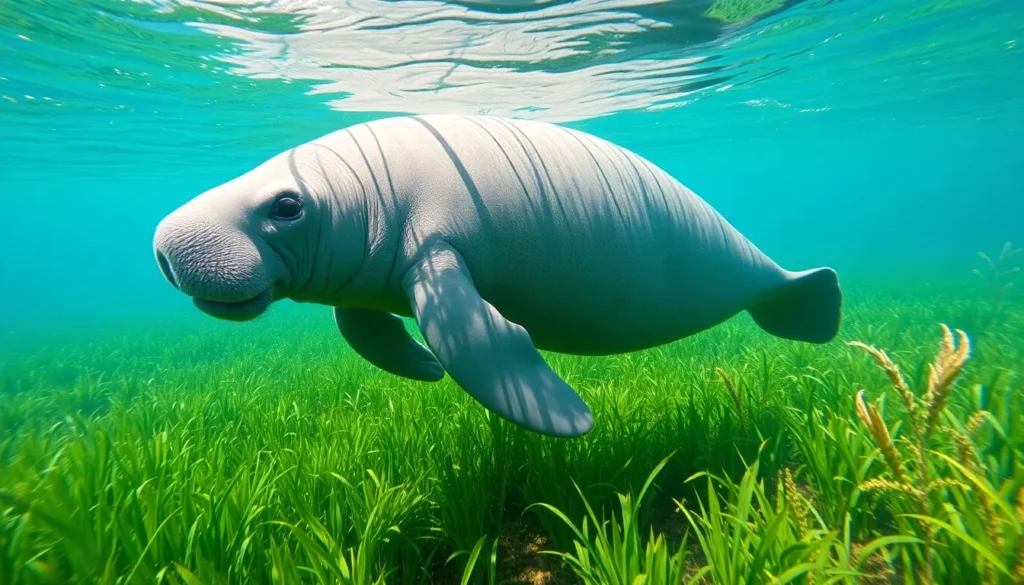
Short Answer
21 Facts About Manatees
- Manatees are aquatic mammals.
Manatees belong to the order Sirenia and are fully aquatic, spending their entire lives in water. - They are often called “sea cows.”
This nickname comes from their slow movement and herbivorous diet, similar to cows grazing on land. - Manatees are herbivores.
They primarily feed on a variety of aquatic plants such as seagrasses and freshwater vegetation. - There are three species of manatees.
The West Indian manatee, Amazonian manatee, and West African manatee are the three recognized species. - Manatees can grow quite large.
Adults typically measure around 9 to 13 feet in length and weigh between 800 to 1,200 pounds. - They have a slow metabolism.
This contributes to their slow movements and low reproductive rate. - Manatees are vulnerable to cold water.
They prefer warm water habitats and can suffer from cold stress syndrome if exposed to temperatures below 68°F (20°C). - They surface to breathe.
Manatees are mammals and must surface regularly to breathe air, typically every 3 to 5 minutes but can hold their breath longer when resting. - Manatees have no natural predators.
Adult manatees have few natural enemies, though young calves may be vulnerable to large predators like crocodiles. - They communicate through vocalizations.
Manatees produce a variety of sounds such as chirps, whistles, and squeaks for communication, especially between mothers and calves. - Manatees exhibit slow reproductive rates.
Females give birth to a single calf after about a 12-month gestation period, with calves staying with their mothers for up to two years. - They have a unique paddle-shaped tail.
Their flat, rounded tail helps them propel through water efficiently. - Manatees have thick, wrinkled skin.
The skin can be covered with algae and small organisms, which sometimes gives them a greenish appearance. - They are important for aquatic ecosystems.
By grazing on aquatic vegetation, manatees help maintain healthy seagrass beds and waterway balance. - Manatees are protected by law.
In many countries, including the United States, manatees are protected by wildlife conservation laws due to their vulnerable status. - Boat collisions are a major threat.
Manatees are often injured or killed by boat propellers, especially in shallow, coastal areas with heavy boat traffic. - Manatees exhibit curious and gentle behavior.
They are known to approach humans and boats in a non-aggressive manner, which sometimes leads to human interactions. - They can live up to 60 years in the wild.
Their lifespan is relatively long compared to many other marine mammals. - Manatees have dense bones.
Their heavy, dense bones help them stay submerged and manage buoyancy underwater. - They use their sensitive whiskers for navigation.
Manatees have tactile hairs called vibrissae around their mouths and bodies, which help them detect objects and navigate murky waters. - Manatees have a slow swimming speed.
Typically, they swim at 3 to 5 miles per hour but can reach bursts of up to 15 miles per hour if necessary.
Habitat and Behavior
Manatees inhabit warm coastal waters, rivers, and freshwater springs primarily in the southeastern United States, the Amazon basin, and West Africa, depending on the species. They prefer shallow waters with abundant vegetation for feeding. Manatees are mostly solitary but may congregate in warm water refuges during colder months. Their slow movements, herbivorous diet, and air-breathing requirements shape much of their behavior. They spend much of their time grazing on aquatic plants, resting underwater, and surfacing regularly to breathe. Manatees also migrate seasonally to access warmer habitats during winter.
Why This Animal Matters
Manatees play a crucial ecological role by maintaining healthy aquatic ecosystems through their grazing, which helps control the growth of aquatic plants and promotes biodiversity. Their presence indicates healthy seagrass bed environments, which are essential for carbon sequestration and water quality. Culturally, manatees have featured in folklore and local traditions in regions where they live. Conservation efforts for manatees also highlight broader issues of habitat protection, water quality, and human impacts on marine life.
Common Misconceptions
Misconception: Manatees are slow and lazy.
Correction: While manatees move slowly to conserve energy, they are not lazy; their slow metabolism and ecological adaptations require this pace to survive.
Misconception: Manatees are fish.
Correction: Manatees are mammals, not fish. They breathe air, give live birth, and nurse their young.
Misconception: Manatees do not have any natural predators.
Correction: Although adult manatees have few predators, calves can fall prey to crocodiles and large sharks in some regions.
Misconception: Manatees can survive in cold water.
Correction: Manatees are sensitive to cold water and require warm environments; exposure to cold can cause illness or death.
FAQ
What do manatees eat?
Manatees are herbivores that primarily consume a variety of aquatic plants such as seagrasses, algae, and freshwater vegetation.
Where do manatees live?
Manatees inhabit warm coastal waters, rivers, and freshwater springs in regions including the southeastern United States, the Amazon basin, and West Africa.
Are manatees endangered?
Manatees are classified as vulnerable due to threats like habitat loss, boat collisions, and cold stress, but they are protected by conservation laws in several countries.



Leave a Reply