Neon, with its distinctive glow and vibrant hues, has fascinated both scientists and the general populace since its discovery. This noble gas, part of the same group in the periodic table as helium and argon, holds more than just its luminescent aesthetics. Here are some intriguing facts about neon that shed light on its unique properties, applications, and the science behind its enchanting glow.
1. Discovery and Etymology
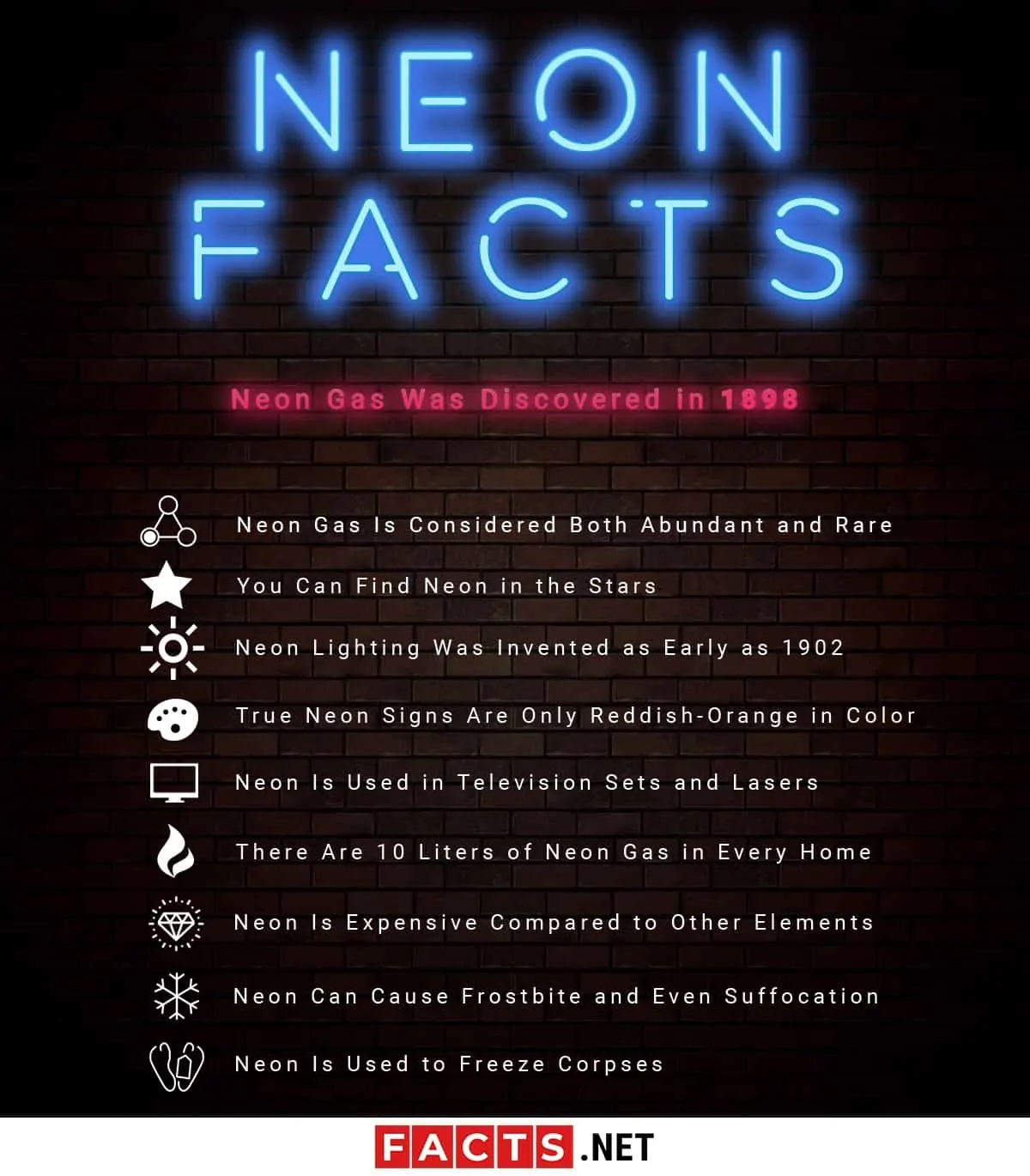
Neon was discovered in 1898 by British chemists William Ramsay and Morris Travers while they were isolating components of liquefied air. The name ‘neon’ derives from the Greek word ‘neos,’ meaning ‘new,’ reflecting its status as a newly identified element at that time. Its discovery marked a significant advancement in the understanding of noble gases, a class of elements known for their low reactivity.
2. Noble Gas Characteristics
Belonging to Group 18 of the periodic table, neon is characterized by its full valence electron shell. This configuration makes it chemically inert, as it does not readily engage in chemical reactions. While this stability contributes to its lack of natural compounds, neon does participate in specific electrical discharge phenomena, illuminating its potential in various applications.
3. Spectacular Spectra
The primary allure of neon lies within its ability to produce light. When an electrical current is passed through neon gas, it emits a bright reddish-orange glow. This is a result of electrons absorbing energy and subsequently releasing it as light when they return to their ground state. The unique spectrum emitted by neon is composed of various wavelengths, each contributing to its captivating visual display. Notably, neon’s spectral lines are utilized in scientific research and analysis, particularly in spectroscopy.
4. Illuminating the Night: Neon Lighting
Neon lighting, particularly in the form of neon signs, has become an iconic representation of urban nightlife. The use of neon in these signs involves filling glass tubes with the gas and applying high voltage to produce neon’s characteristic glow. While neon lighting is often seen as solely reddish-orange, it can be manipulated with phosphor coatings to emit a myriad of colors. This versatility explains neon’s continued popularity in advertising and art.
5. Natural Occurrence and Abundance
Neon is one of the rarest elements in the Earth’s atmosphere, constituting approximately 0.0018% of the air we breathe. Despite its scarcity, it can be harvested through fractional distillation of liquid air. In nature, neon is often found in trace amounts within certain minerals and is a product of radioactive decay. Its rarity contributes to its higher market value compared to more common elements.
6. Applications Beyond Signage
Beyond its mesmerizing glow in neon signs, this noble gas is employed in various practical applications. Neon is used in gas laser technology, especially in excimer lasers, which are pivotal in medical and industrial applications. These lasers are instrumental in procedures like LASIK eye surgery, showcasing how this exotic gas plays a role in advancing contemporary medicine.
7. Cryogenic Usage
Neon finds a critical niche in cryogenics, where it is utilized as a refrigerant. Due to its low boiling point of -246.1 degrees Celsius, neon can efficiently cool objects to ultra-low temperatures. This property is essential in certain superconducting technologies and scientific research, where maintaining specific thermal conditions is paramount.
8. Aesthetic Purity: The Color of Neon
Neon signs derive their striking colors not just from the gas itself, but from the glass tubes they’re encased in. When coated with specific phosphorescent materials, they can produce various colors ranging from blue to green. The colors represent a fusion of the noble gas’s incandescent properties and engineered materials that modify its emitted light, thereby broadening its artistic expression.
9. Enlightening Scientific Research
Neon’s inert nature allows it to serve as an ideal tracer gas in scientific studies. Researchers utilize neon in experiments measuring diffusion rates in gases and investigating fluid dynamics, where its stability and non-reactivity are highly valued. The insights gained from such research enhance our comprehension of fundamental physical processes.
10. Cultural Significance
Neon lighting has transcended its commercial origins to become a symbol of contemporary culture. From the vibrant neon-lit streets of big cities to art installations and museums, its presence is impactful. Neon represents not only technological advancement but also a form of expression, embodying the spirit of innovation and the promise of what artificial light can represent in human creativity.
11. Future Possibilities
The future of neon continues to hold promise. As renewable energy technologies burgeon, the potential for neon in high-efficiency lighting and display technologies is being re-examined. Moreover, advancements in new materials might pave the way for even more vivid and diverse color applications in art and signage.
In conclusion, neon encapsulates a realm of scientific wonder and cultural significance. Its unique properties and uses inspire curiosity and admiration, illuminating a pathway to deeper understanding and appreciation of both chemistry and creativity. As technologies evolve, the legacy of neon will undoubtedly glow brighter, continuing to captivate imaginations worldwide.