
Short Answer
21 Facts About Earth
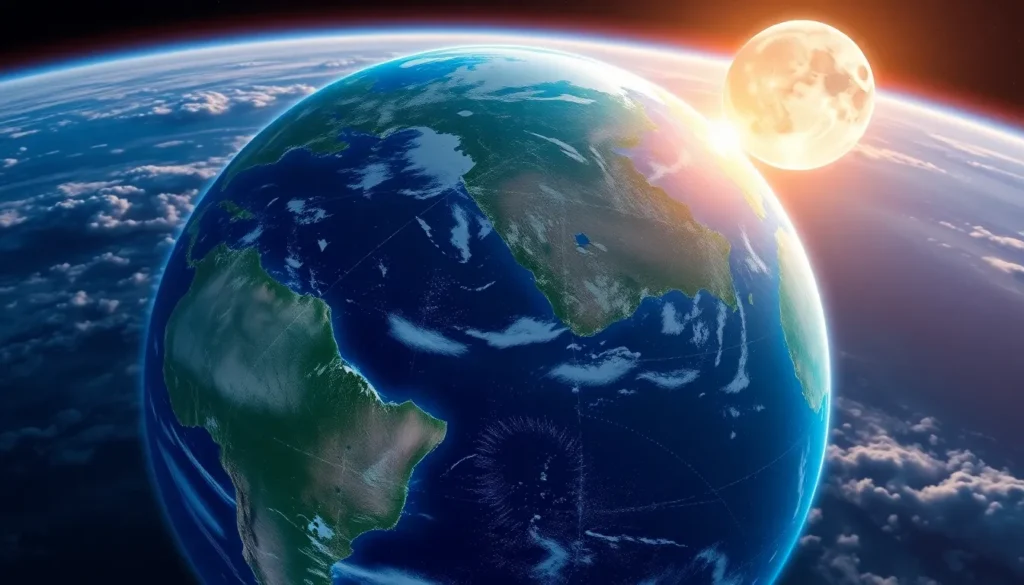
- Earth is the third planet from the Sun. It orbits the Sun at an average distance of about 93 million miles (150 million kilometers), placing it in the habitable zone where liquid water can exist.
- Earth is the only known planet to support life. Its atmosphere, presence of water, and suitable temperature range make it uniquely capable of sustaining diverse biological ecosystems.
- Earth’s diameter is approximately 12,742 km (7,918 miles). It is the fifth-largest planet in the solar system by diameter.
- About 71% of Earth’s surface is covered by water. The oceans contain 97% of Earth’s water, while the rest is found in glaciers, ice caps, groundwater, lakes, and rivers.
- Earth has a layered internal structure. It consists of a crust, mantle, outer core, and inner core, each with distinct compositions and physical properties.
- Earth’s atmosphere is composed mainly of nitrogen (78%) and oxygen (21%). Trace gases include argon, carbon dioxide, and water vapor.
- The planet’s magnetic field is generated by the movement of molten iron in its outer core. This geomagnetic field protects Earth from harmful solar radiation and cosmic rays.
- Earth experiences tectonic activity. Its lithosphere is divided into plates that move slowly, causing earthquakes, volcanic eruptions, and mountain formation.
- Earth’s rotation causes day and night. It completes one full rotation approximately every 24 hours.
- Earth’s axial tilt of about 23.5 degrees creates the seasons. This tilt affects the intensity and duration of sunlight received at different latitudes throughout the year.
- The Moon is Earth’s only natural satellite. It influences tides and stabilizes Earth’s axial tilt.
- Earth’s atmosphere extends up to about 10,000 km but becomes very thin at higher altitudes. Most weather phenomena occur within the lowest 12 km, called the troposphere.
- Earth has a diverse range of climates and biomes. These vary from polar ice caps to tropical rainforests, supporting a wide variety of life forms.
- Earth’s surface is constantly changing. Erosion, sedimentation, volcanic activity, and plate tectonics continually reshape the landscape.
- Earth’s gravity is approximately 9.8 m/s² at sea level. This force keeps the atmosphere and all objects anchored to the surface.
- Earth’s atmosphere helps regulate the planet’s temperature. The greenhouse effect traps heat, making the planet warm enough to support life.
- Earth’s oldest known rocks are about 4 billion years old. These provide evidence of the planet’s formation and early history.
- Earth is estimated to be about 4.54 billion years old. This age is based on radiometric dating of meteorites and ancient terrestrial rocks.
- Earth’s biosphere interacts with the geosphere, atmosphere, and hydrosphere. These interactions regulate global systems such as climate and nutrient cycles.
- Human activity significantly impacts Earth’s environment. Issues such as deforestation, pollution, and climate change affect ecosystems and planetary health.
- Earth is part of the Milky Way galaxy. It orbits the galactic center along with billions of other stars and their planetary systems.
How It Works
Earth functions as a complex system where geological, atmospheric, hydrological, and biological processes interact. Its internal heat drives plate tectonics, recycling materials and shaping the surface. The atmosphere regulates temperature and protects life from solar and cosmic radiation. Water cycles through evaporation, precipitation, and runoff, supporting ecosystems and regulating climate. The magnetic field generated by the molten outer core shields the planet from charged particles emitted by the Sun. Earth’s position in the solar system provides the right conditions for liquid water and stable climates, essential for sustaining life.
Why It Matters
Understanding Earth is crucial because it is our home and the only known planet supporting life. Studying Earth’s systems helps predict natural disasters, manage natural resources, and address environmental challenges such as climate change. Knowledge of Earth’s processes supports sustainable development and conservation efforts. Moreover, Earth serves as a reference point for studying other planets and the potential for life elsewhere in the universe. Protecting Earth ensures the survival of diverse species, including humans, and maintains the planet’s habitability for future generations.
Common Misconceptions
Misconception: Earth is a perfect sphere.
Correction: Earth is an oblate spheroid, meaning it is slightly flattened at the poles and bulges at the equator due to its rotation.
Misconception: The seasons are caused by Earth’s distance from the Sun.
Correction: Seasons result from Earth’s axial tilt, not its distance from the Sun. The tilt affects the angle and intensity of sunlight received, causing seasonal changes.
Misconception: Earth’s magnetic field is constant and unchanging.
Correction: Earth’s magnetic field fluctuates over time and even reverses polarity approximately every several hundred thousand years.
Misconception: The Moon causes solar eclipses every month.
Correction: Solar eclipses occur only when the Moon passes between Earth and the Sun during a new moon and the alignment is precise, which happens infrequently.
Misconception: The atmosphere is very thick and extends evenly far into space.
Correction: Earth’s atmosphere is densest near the surface and gradually thins out with altitude, becoming nearly a vacuum beyond about 100 km.
FAQ
Why is Earth called the Blue Planet?
Earth is called the Blue Planet because over 70% of its surface is covered by water, which appears blue from space due to the absorption and scattering of sunlight.
How does Earth's magnetic field protect life?
Earth’s magnetic field deflects charged particles from the solar wind and cosmic rays, preventing them from stripping away the atmosphere and harming living organisms.
What causes Earth's seasons?
Earth's seasons are caused by its axial tilt of about 23.5 degrees, which changes the angle and duration of sunlight received at different locations during its orbit around the Sun.



Leave a Reply