
Short Answer
Black holes have long captivated the imagination of scientists and enthusiasts alike. These enigmatic cosmic phenomena challenge our understanding of physics, space, and time itself. As we delve into the depths of these gravitational giants, prepare for a journey filled with astonishing revelations that may just shift your perspective on the universe as you know it. Here are 30 mind-bending facts about black holes that will pique your curiosity and ignite your interest in the mysteries of the cosmos.
1. **What is a Black Hole?** A black hole is a region in space where the gravitational pull is so strong that nothing, not even light, can escape from it. This definition makes black holes one of the most elusive objects in the universe.
2. **Formation through Stellar Collapse:** Black holes typically form from the remnants of a massive star undergoing gravitational collapse after exhausting its nuclear fuel. This process can lead to a supernova explosion, leaving behind a black hole.
3. **Three Types of Black Holes:** They can be categorized into three primary types: stellar black holes, supermassive black holes, and intermediate black holes. Stellar black holes are formed from single stars, whereas supermassive ones lurk at the centers of galaxies, holding millions or billions of solar masses.
4. **Supermassive Specters:** Every galaxy that we have observed contains a supermassive black hole at its center. Our own Milky Way is no exception, harboring the black hole known as Sagittarius A*.
5. **Event Horizon:** The event horizon of a black hole is the boundary beyond which nothing can escape the gravitational pull. Crossing this threshold is a one-way trip; the laws of physics as we know them cease to function.
6. **Spaghettification:** The extreme gravitational gradient near a black hole leads to a phenomenon known as spaghettification. Objects approaching the event horizon are stretched and compressed, resembling spaghetti, hence the name.
7. **Time Dilation:** According to Einstein’s theory of relativity, time behaves differently in strong gravitational fields. As one approaches a black hole, time appears to slow down relative to a distant observer, creating a fascinating paradox.
8. **Hawking Radiation:** Proposed by physicist Stephen Hawking, this groundbreaking theory suggests that black holes can emit radiation due to quantum mechanical effects near the event horizon, allowing them to lose mass and possibly evaporate over time.
9. **No Hair Theorem:** This fascinating principle posits that black holes can be fully described by just three observable properties: mass, electric charge, and angular momentum. The various complexities of a star’s identity are lost beyond the event horizon.
10. **Black Holes and Wormholes:** Speculative theories suggest that black holes could be gateways to other parts of the universe or even to different dimensions, potentially manifesting as wormholes that connect disparate points in spacetime.
11. **Black Hole Collisions:** When two black holes collide, they create ripples in spacetime known as gravitational waves. These waves were first detected in 2015, confirming a long-predicted phenomenon and opening new avenues in astrophysics.
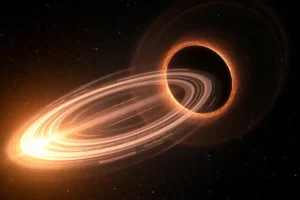
12. **Accretion Disks:** The visible halos of light surrounding certain black holes are known as accretion disks. These disks, composed of gas and dust spiraling toward the black hole, release immense amounts of energy as they become heated by gravitational forces.
13. **Size Matters:** While stellar black holes are typically 3 to 20 times the mass of our sun, supermassive black holes can range from millions to billions of solar masses. This variation showcases the spectrum of formation processes in the cosmos.
14. **Possible Existence Beyond the Observable Universe:** There are theories suggesting that if black holes exist, there may even be regions beyond the observable universe populated with numerous black holes. This challenges our comprehension of the universe’s boundaries.
15. **Pulsars and Black Holes:** Pulsars, which are rapidly spinning neutron stars emitting beams of radiation, can sometimes be found in binary systems with black holes. The interaction between the two can reveal important details about the nature of black holes.
16. **Black Hole Paradox:** The black hole information paradox raises questions about what happens to information when matter falls into a black hole. This debate threatens the very foundations of quantum mechanics and thermodynamics.
17. **Formation of Galactic Structures:** The existence of supermassive black holes at the centers of galaxies may have crucial implications on the formation and evolution of galaxies themselves, influencing their size and structure over time.
18. **Galactic Cannibalism:** Supermassive black holes can devour other stars and black holes, contributing to their dizzying growth. Such interactions provide insights into the dynamics of cosmic evolution.
19. **Absence of Direct Observation:** Despite extensive research and indirect evidences, no one has ever directly observed a black hole. Instead, astronomers detect their presence through the gravitational effects on nearby celestial bodies.
20. **Black Holes and Dark Matter:** The study of black holes offers intriguing possibilities regarding dark matter. Certain theories postulate that black holes could be composed of dark matter or play a role in the formation of dark matter halos surrounding galaxies.
21. **Quantum Mechanics and Black Holes:** The intersection of quantum mechanics and general relativity around black holes challenges physicists to reevaluate the compatibility of these foundational theories—sparking innovative research opportunities.
22. **Black Holes and the Fate of Stars**: When a star runs out of fuel, its fate is determined by its mass. Smaller stars become white dwarfs, while larger ones may culminate in a spectacular supernova, eventually leading to black hole formation.
23. **The Milky Way’s Monster:** Sagittarius A*, the black hole at the center of the Milky Way, has a mass equivalent to about 4.3 million suns. It acts as an anchor, influencing the orbital behaviors of countless stars.
24. **Astronomical Distances:** The nearest known black hole, V616 Monocerotis, is roughly 3,000 light-years away. This vast distance underscores the scale of the universe and the challenges faced by scientists studying these cosmic giants.
25. **Ring of Light:** The Event Horizon Telescope captured an unprecedented image of a black hole’s shadow in 2019, embedding the enigmatic structure deeply in our collective consciousness. This groundbreaking achievement marked a milestone in astronomical history.
26. **Simulated Black Holes:** Physicists utilize simulations to better understand the behavior of black holes and their surroundings. These simulations often yield breathtaking visualizations, showcasing complex interactions in a captivating manner.
27. **Potential for Life:** Though intimidating, black holes are only one aspect of the cosmos. Their existence does not preclude the potential for life elsewhere, but rather allows us to ponder on the multitude of environments that could harbor life.
28. **Changing Views:** Just as technological advancements have reshaped our perspectives, the study of black holes challenges preconceived notions of space. They embody the notion that vast expanses can conceal realms of unexpected phenomena.
29. **The Multiverse Theory**: Some speculative theories suggest that black holes could lead to the creation of new universes, contributing to the multiverse concept, where an infinite number of worlds coexist alongside our own.
30. **Foreboding and Fascination:** Lastly, black holes encapsulate the duality of human emotion: fear and allure. They represent the unknown, provoking awe while challenging our understanding of the universe.
In conclusion, black holes stretch the limits of our imagination and challenge our scientific comprehension. Each fact sheds light on the complexities of these cosmic enigmas, urging us to rethink our understanding of space, time, and the very nature of reality. They serve not only as profound subjects of scientific inquiry but also as a reminder of the vast mysteries awaiting our exploration—all within the ever-expanding canvas of the universe.
FAQ
What is Hawking Radiation?
Hawking Radiation is a theoretical prediction that black holes can emit radiation due to quantum effects near the event horizon.
What is the Event Horizon?
The Event Horizon is the boundary surrounding a black hole beyond which nothing can escape its gravitational pull.



Leave a Reply